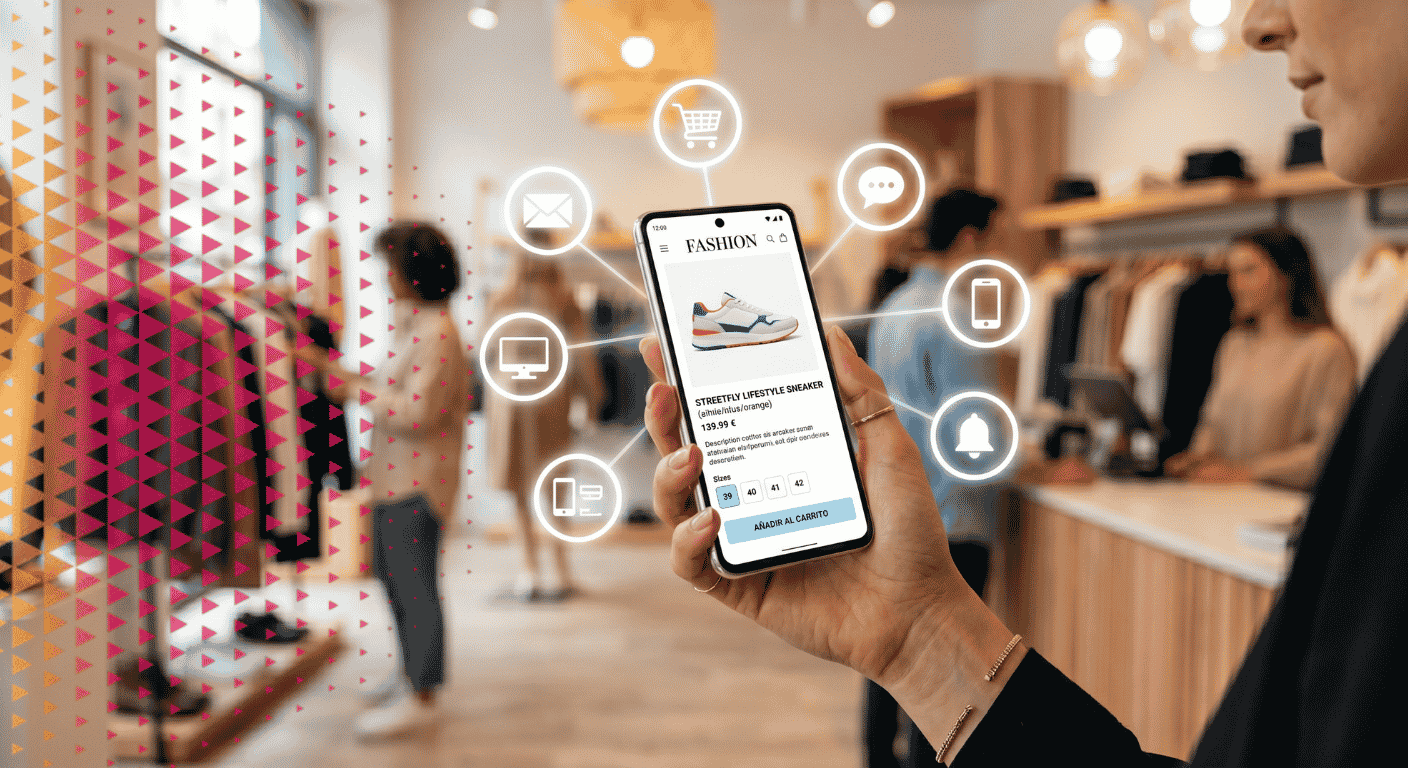


E-commerce with AI: optimize your merchandising and your conversion

Artificial intelligence is transforming digital commerce at a lightning speed. Today, talking about AI in e-commerce is no longer a trend, but a necessity to stay competitive. Online stores that integrate intelligent solutions succeed in optimizing key processes such as e-commerce merchandising, internal search, and cross-selling. In this way, they not only improve the customer experience, but also increase conversion rate optimization as well as the average basket.
In this context, applying AI to e-commerce involves both automating tasks and better understanding the customer. We explore below how to optimize your e-commerce site with AI on the most strategic aspects.
What is e-commerce merchandising and what is its influence on sales?
E-commerce merchandising (or e-merchandising) encompasses all actions aimed at presenting products in an attractive and strategic way within an online store. Its objective is to guide the user towards the act of purchase, by facilitating navigation and highlighting key products from your product catalog.
Good e-commerce merchandising has a direct impact on conversion. For example, sorting products by popularity, displaying recommendations or highlighting offers improves visibility and reduces friction in the buying journey. In addition, an e-merchandiser who relies on customer data analysis can make wiser decisions about which products to display and the appropriate time to do so.
E-commerce visual merchandising and user experience
E-commerce visual merchandising focuses on the visual presentation of products, including images, videos, category design and the layout of elements on the site. All of this influences the user’s perception of the store. A neat visual experience increases session time and the probability of purchase. For example, using high-quality images or creating compositions simulating physical windows can generate a stronger emotional impact.
How to apply AI in e-commerce: search and personalization
The integration of artificial intelligence in e-commerce allows for the optimization of key processes such as search and personalization. These two pillars are fundamental to improving the customer experience and boosting conversion.
Personalization based on AI analyzes user behavior, their preferences, their purchase history and what other people with similar tastes have bought. Thus, it is possible to offer more relevant recommendations and increase the probability of purchase. This approach is particularly effective for stores with a large product catalog.
E-commerce search with AI and intelligent engines
Search within an e-commerce site with AI has evolved a lot in recent years. Current e-commerce search engines are no longer limited to simple keywords, but now understand the real intention of the user.
For example, an intelligent search engine can interpret typographical errors, synonyms or even natural language. This significantly improves the customer experience and reduces the abandonment rate.
In addition, learning how to improve e-commerce search involves analyzing the most frequent queries and adjusting the results accordingly. AI allows this to be done automatically, thus optimizing performance continuously.
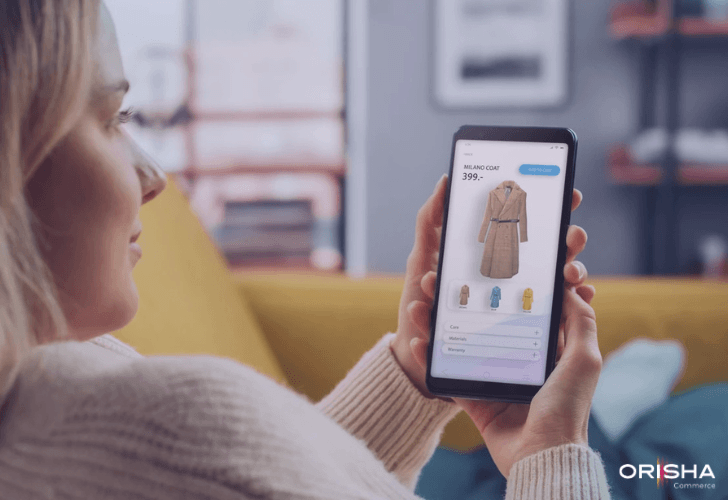
Cross-selling and merchandising: the keys to increasing the average basket
Cross-selling is one of the most effective strategies for increasing the average value of each purchase on an e-commerce site. When combined with a good merchandising approach, it allows not only to sell more, but to do so in an intelligent way aligned with the customer’s needs. Here is a summary of the key points:
- Offering complementary products: cross-selling consists of suggesting items that complement the main purchase, thus increasing the value of the basket.
- Applying it at strategic moments: displaying associated products on the product page or during the payment process (checkout) can directly influence the purchase decision.
- Prioritizing relevance: recommendations must be useful and consistent with the user’s search, avoiding being intrusive or forced.
- Relying on artificial intelligence: AI allows for the analysis of purchase patterns and behavior to predict which products are most likely to be sold together.
- Integrating it within e-commerce merchandising: combining these recommendations with a neat visual presentation and a rigorous organization of products reinforces their effectiveness.
Applied correctly, cross-selling not only increases sales, it also improves the customer experience by facilitating access to complete solutions in a single purchase.
Examples of cross-selling in e-commerce
Cross-selling can be applied in multiple ways within an e-commerce site. Here are some of the most effective examples:
- Suggesting accessories with the main product: for example, if a customer buys a smartphone, offering them a case, a screen protector or headphones.
- Displaying products “often bought together”: a technique based on real data of user behavior, widely used by large marketplaces.
- Including personalized recommendations: both in emails and on the home page, adapted to the interests and previous purchases of the customer.
- Offering complements in the basket or at checkout: just before finalizing the order, to increase its value.
- Highlighting packs or bundles: grouping related products with a small incentive can facilitate the purchase decision.
These actions, well executed, not only increase the average basket, but also improve the customer experience by offering them more complete solutions.
AI tools to optimize your e-commerce
There are multiple AI tools for e-commerce designed to improve the performance of an online store, ranging from intelligent search engines to personalization and predictive analysis systems.
For example, search engines equipped with AI allow for more precise results, while personalization platforms adapt products and content according to user behavior. To this are added analysis tools that help make decisions based on real data.
In this context, it is appropriate to differentiate solutions directly focused on the optimization of e-commerce from those that support the entire operations of the company.
On the one hand, tools like Tweakwise, from Orisha Commerce, are specialized in improving the online shopping experience via features such as intelligent search powered by AI, dynamic filters or personalized recommendations. This type of solution allows for the optimization of e-commerce merchandising and enables the user to find what they are looking for more quickly and easily.
On the other hand, the Orisha Commerce ecosystem provides the necessary basis for this entire process to work in an integrated way, connecting aspects such as order management, available stocks, the customer or loyalty within the same environment.
In this way, it is possible to apply advanced e-commerce search strategies with AI and personalization, while ensuring that the entire business operations are aligned and optimized. Choosing the right tool will depend on your activity, but the essential thing is to rely on solutions that not only improve conversion, but also connect all the contact points of e-commerce.
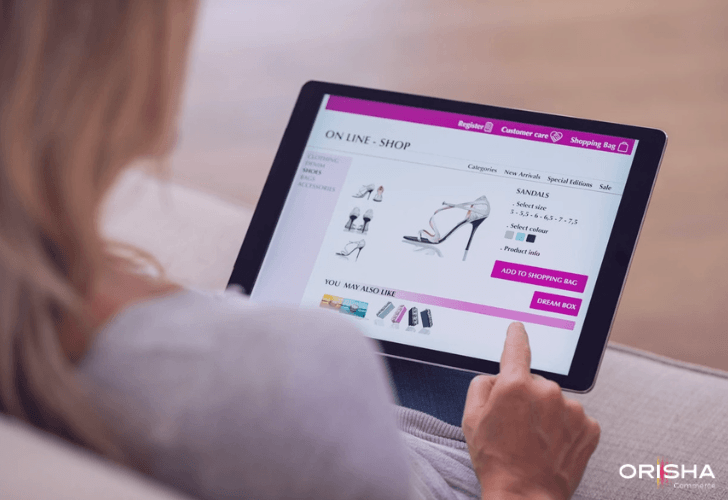
Benefits of AI in e-commerce: conversion and experience
Artificial intelligence has become a key element for improving the performance of any online store. Its application allows for the optimization of both conversion and customer experience, directly impacting the company’s results. If you want to see how this applies concretely, this webinar on the transformation of the online shopping experience by AI explains it with real examples.
Increase in conversion
AI allows for offering personalized experiences and more relevant recommendations, which increases the probability of purchase.
Improvement of the customer experience
It facilitates navigation, optimizes search and reduces friction points throughout the buying journey.
Greater satisfaction and loyalty
By adapting to the customer’s needs, it generates a smoother and more pleasant experience, favoring repurchase.
Operational efficiency
It automates tasks such as product management, recommendations or analysis of customer data, optimizing resources and reducing costs.
Competitive advantage
In an increasingly demanding environment, integrating AI in e-commerce allows for differentiation and offering a more solid value proposition.
Applying artificial intelligence not only improves short-term results, but also lays the foundations for sustainable growth.
Orisha Commerce: boost your e-commerce thanks to AI
At Orisha Commerce, we bet on a smarter way to manage digital commerce. We know that improving merchandising, optimizing e-commerce search with AI and strengthening cross-selling are not isolated actions, but are part of a global strategy oriented towards results.
That is why we develop e-commerce solutions with AI that allow for connecting all these points from a single environment. With tools such as our intelligent search engines, our advanced personalization systems or our unified commerce platforms, we help adapt each shopping experience to the real needs of each user.
In addition, our unified commerce and omnichannel management solutions allow for integrating inventory, orders and the customer in real time, thus facilitating faster and more precise decisions. This translates into a direct improvement in conversion and a more consistent and fluid shopping experience.
We work so that you can anticipate customer behavior, automate key processes and evolve your e-commerce on a solid technological base oriented towards growth.
If you want to improve the conversion and experience of your e-commerce thanks to AI, we can help you. Request a demo and we will show you how to apply it to your particular case.
FAQ
What is e-commerce merchandising?
E-commerce merchandising is the set of techniques used to present products in an attractive and strategic way. Its objective is to improve the customer experience and increase sales.
How to improve search on an e-commerce site?
To improve e-commerce search with AI, it is necessary to implement an intelligent search engine. This must be capable of understanding the user’s intention, offering relevant results and adapting continuously.
What AI tools to use in e-commerce?
The most common tools include intelligent search engines, recommendation systems and customer data analysis platforms. All contribute to optimizing e-commerce performance.
How to apply cross-selling in e-commerce?
Cross-selling is applied by offering complementary products at key moments of the buying journey. It is important that recommendations are relevant and not intrusive.