


Gartner POS 2025 guide: the criteria that are truly useful for choosing a unified commerce platform

The Gartner® Market Guide 2025 should not be read as a simple list of vendors, but as a strategic framework for modernizing your POS. For a retailer, the criteria that are truly useful are those that connect the point of sale (POS) to unified commerce: real-time data, cloud and modular architecture, store mobility, OMS/CRM/e-commerce integration, operational AI, and large-scale deployment capability. Orisha Commerce, recognized for Openbravo POS, is part of this evolution toward a POS that has become the nerve center of the unified customer experience.
Why the Gartner POS guide matters to retailers
The point of sale is evolving rapidly: between unified commerce, omnichannel strategies, and the rise of AI, the POS is becoming a central element of the retail system, but it is also more complex to scale and evolve (integration, data, customer experience).
In this context, the Gartner® Market Guide 2025 brings value with a structured overview of the market: key trends (AI-augmented POS, cloud, modular architectures), essential functionalities, a vendor panorama, and modernization recommendations.
What is the purpose of the Gartner POS guide?
To structure decision-making: understanding the options, prioritizing needs, and framing a POS modernization strategy tailored to your retail challenges.
The Gartner POS 2025 guide: a compass, not a ranking
Market Guide vs. decision grid
Gartner’s Market Guide on unified commerce is neither a prize list nor a turnkey comparison of the best software vendors.
Unlike a Magic Quadrant, it does not position players according to a logic of leaders, challengers, or visionaries. Its objective lies elsewhere: to provide a structured analysis of a market, explaining its dynamics, its major categories of solutions, its evaluation criteria, and its technological evolutions.
The risk for a retailer would therefore be to misuse it as a simplistic decision grid by looking for “the best tool.” In reality, the guide serves instead as a compass to understand the available options and ask the right questions.
What a retailer must take away from the Gartner POS 2025 guide
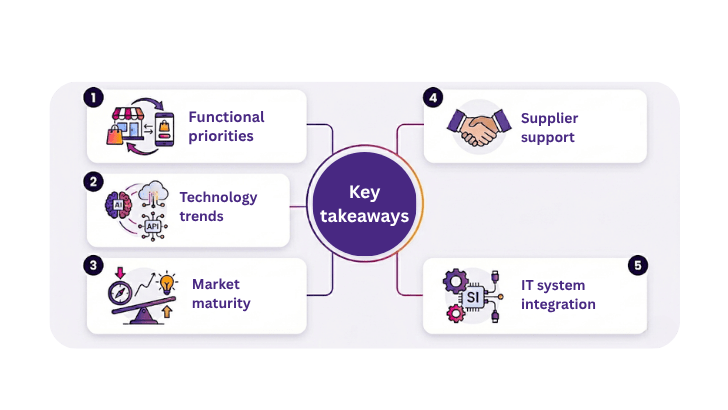
To make it a useful tool internally, focus on the essentials:
- Your functional priorities (what really creates value in-store and across omnichannel channels).
- Technological trends to anticipate (AI, cloud, APIs, etc.).
- Market maturity (level of risk and innovation).
- Integration challenges with your IT ecosystem.
- The ability of suppliers to support you.
In short: use the guide to structure your thinking, then adapt it to your field realities before deciding.
The criteria that are truly useful for evaluating a POS solution
1) The POS as a hub for unified commerce
Today, the POS is no longer just used for checking out: as the nerve center of unified commerce, it must make it possible to orchestrate sales, inventory, returns, clienteling, loyalty, and store data all at once.
This translates in particular into seamless integration with other systems: Order Management System (OMS), Enterprise Resource Planning (ERP), Customer Relationship Management (CRM) software…
2) Real-time data and a unified customer view
Collecting and analyzing real-time data across all channels stands out as an essential criterion for a good POS solution.
Acting as a true bridge between inventory, orders, CRM, customer history, and loyalty, customer data analysis offers a unified customer view, which is essential for managing in-store sales, but also other processes like Click & Collect and Ship from Store.
3) Cloud, modular, and interoperable architecture
To facilitate data exchange, a POS must comply with the main principles of MACH architecture (microservices, API-first, cloud-native, headless):
- Connected: designed to be optimized within an ecosystem, it works in real time with OMS, CRM, and e-commerce systems, following an API-first approach.
- Modular: it features functionalities that can be assembled, replaced, and evolved independently.
- Open: each component is documented and independently observable.
4) In-store mobility and sales associate experience
A modern POS provides sales associates with mobile tools and centralized interfaces (“super-apps”) that streamline tasks and offer a unique view of real-time data across all channels. This improves employee productivity / efficiency, but also the customer experience thanks to reduced waiting times, a smoother checkout experience, or even more personalized support.
5) Useful AI, without gimmicks
POS software is no exception to the Artificial Intelligence phenomenon, which opens up a multitude of new possibilities. However, beyond the marketing argument, it is necessary to identify the AI features that bring real added value, notably:
- Generating forecasts and personalized offers, allowing to increase sales and automatically activate rewards and discounts during the checkout experience.
- Automating markdowns, optimizing replenishment, and reducing waste thanks to predictive monitoring of inventory-related signals.
- Better coordination of workflows related to sales, services, and marketing.
- Simplifying real-time decision-making and predictive analysis.
- Empowering sales associates and personalized customer engagement.
- Detecting fraud and anomalies.
6) Scalability and internationalization
Finally, the best POS software stands out for its flexibility, resilience, and capacity to adapt to future developments. Therefore, a modular and scalable solution should be prioritized, allowing for a progressive deployment while guaranteeing data and payment security.
In the context of international development, supporting multi-country tax and country compliance is also a crucial aspect.
How to transform these criteria into an evaluation grid?
|
Gartner criterion |
Example of question to ask |
Expected proof |
Risk in case of absence |
|
Unified commerce hub |
Does the tool allow for efficient order management, including Click & Collect and Ship from Store? |
Full integration with the Order Management System (OMS) |
Lack of flexibility in order management |
|
Real-time reporting |
Does the software offer immediate and complete visibility into inventory, products, and customer information? |
Real-time KPI dashboards and advanced analytics modules |
Erroneous decision-making |
|
Modular and headless architecture |
Does the solution allow for the rapid development of custom solutions and the configuration of microservices and user interfaces without having to rely on third-party providers? |
Microservices allowing integration with third-party applications |
Hardware and software dependencies |
|
Customer and sales associate mobility |
Does the POS allow sales associates to support customers anywhere in the store? |
Mobile payment terminals and centralized interfaces |
Degraded customer experience |
|
Artificial Intelligence |
Does the tool improve the employee experience by automating repetitive tasks and providing them with intelligent assistance? |
Assistants based on generative AI and LLMs to help employees quickly find product information, answer customer requests, and manage in-store operations |
Decrease in operational efficiency |

Orisha Commerce: a recognized player in unified commerce
Recognized for the second consecutive year in Gartner’s report on artificial intelligence and unified commerce, Openbravo POS is a modular, cloud-native solution designed to interoperate seamlessly with all types of OMS (Order Management System), Customer Relationship Management (CRM), and e-commerce systems.
|
Through an extended partnership spanning more than 35 countries and regions, Orisha Commerce and Decathlon have deployed Openbravo at scale across over 300 stores in France. The objective is to modernize the in-store experience with a mobile payment solution that eliminates traditional checkout, enhances the customer experience, and empowers sales associates, all as part of a comprehensive digital transformation strategy. |
Equivalenza selected Orisha Commerce to modernize its store management and support international growth, deploying Openbravo across 500 stores in 20 countries. This initiative delivers a unified customer experience across all channels, optimizes store operations, and ensures full country compliance with local fiscal and regulatory requirements. |
Would you like to try the features of Openbravo POS?
How to use the Gartner POS 2025 guide internally?
Gartner’s market guide should not be read as a study, but as a decision-making and alignment tool between the IT department and business lines. To derive maximum value from it internally:
- Build a criteria scoring system (architecture, real-time data, mobility, AI capabilities) aligned with your business priorities.
- Conduct an objective benchmark of the software vendors identified in the guide: use it to frame your request for proposal (shortlist, requirements, evaluation grid).
- Contrast these best practices with the pain points identified in-store (checkout time, stockouts, lack of customer visibility) in order to anchor your transformation in reality.
FAQ
What is a Gartner POS guide?
It is a market analysis report that helps retailers understand trends, key functionalities, and suppliers within a technology segment.
Which criteria should you look for in a Gartner POS guide?
The most useful ones are cloud architecture, omnichannel integration, real-time data, mobility, operational AI, scalability, and integration capacity with the retail ecosystem.
Why is the POS becoming central in unified commerce?
Because it connects the store to orders, available inventory, customer data, returns, loyalty, and digital channels.
Is Openbravo POS recognized by Gartner?
Orisha Commerce indicates that Openbravo POS is recognized for the second consecutive year in the Gartner® Market Guide 2025 dedicated to unified commerce platforms anchored by an AI-enabled POS.