

How a well-chosen POS can boost your revenue

In the retail sector, every interaction is a sales opportunity. Your Point of sale (POS) directly impacts conversion rates, the fluidity of the omnichannel journey, in-store recommendations, and even customer loyalty.
Selecting the right solution profoundly transforms the store experience and optimizes commercial performance. This article details how a unified commerce POS can actively drive sales.
In-store conversion
Minimizing checkout wait times is a critical lever for boosting conversion at the Point of sale (POS). When a store is equipped with a Mobile POS (mPOS) or SoftPOS, sales associates can process payments directly in the aisles or high-traffic zones. This ability to handle peak traffic limits queue abandonment and streamlines the checkout flow. For retailers, it is a straightforward way to increase conversion rate optimization.
Conversion also relies heavily on product availability. With real-time stock visibility, ATP (Available To Promise) and ATS (Available To Sell) data is accessible directly from the checkout. This transparency accelerates purchasing decisions and reduces false stockouts.
Checklist for choosing a POS
API-First architecture for seamless integration with CRM, OMS, eCommerce, and business tools.
Offline mode to keep selling even during network outages.
MDM and SSO for managing touch terminals, access, and updates.
Centralized discounts and promotions engine to apply consistent rules across all channels.
Unified payments: in-store, mobile, Self-checkout, and eCommerce.
Mobile POS and SoftPOS compatibility to multiply touchpoints.
Real-time reporting to track conversion, basket size, UPT, TPS, and acceptance rates.
Basket size & UPT
To increase the average basket size and Units Per Transaction (UPT), the sales associate needs to recommend the right product at the right moment. With a unified commerce POS, cross-selling suggestions appear directly at the checkout. These are based on customer history, recent purchases, preferences, and merchandising rules defined by the retailer. This clienteling approach provides the associate with a detailed insight into the customer profile.
The POS also makes it easy to create and apply bundles and complementary offers. Sales associates can instantly visualize available combinations, available inventory, and customer savings. Centralized management of coupons, loyalty program benefits, and discounts strengthens the impact of recommendations, giving associates the leverage they need to close the sale.
Frequency & loyalty
Driving repeat store visits depends on the retailer’s ability to build a useful and consistent relationship. A POS connected to the customer wallet makes benefits accessible in real-time, regardless of which physical channel or store is visited.
A unified commerce POS also enables the issuance of gift cards, balance checks, and conversion into store credit. Omnichannel journey promotion rules ensure total consistency across eCommerce, apps, and physical stores. This continuity builds trust and boosts engagement with loyalty programs.
Returns & margin
Returns management significantly impacts network profitability. A POS that handles Returns / Refunds at the checkout ensures greater efficiency for teams. Customers get an immediate response, and the retailer retains the sale within its ecosystem. Depending on the policy, the POS can issue store credit, top up a gift card, or instantly return the item to available inventory upon scanning.
Fraud prevention also becomes more effective. The checkout experience accesses proof of purchase and return histories in real-time. Sales associates can verify a product’s origin and validate the receipt’s consistency.
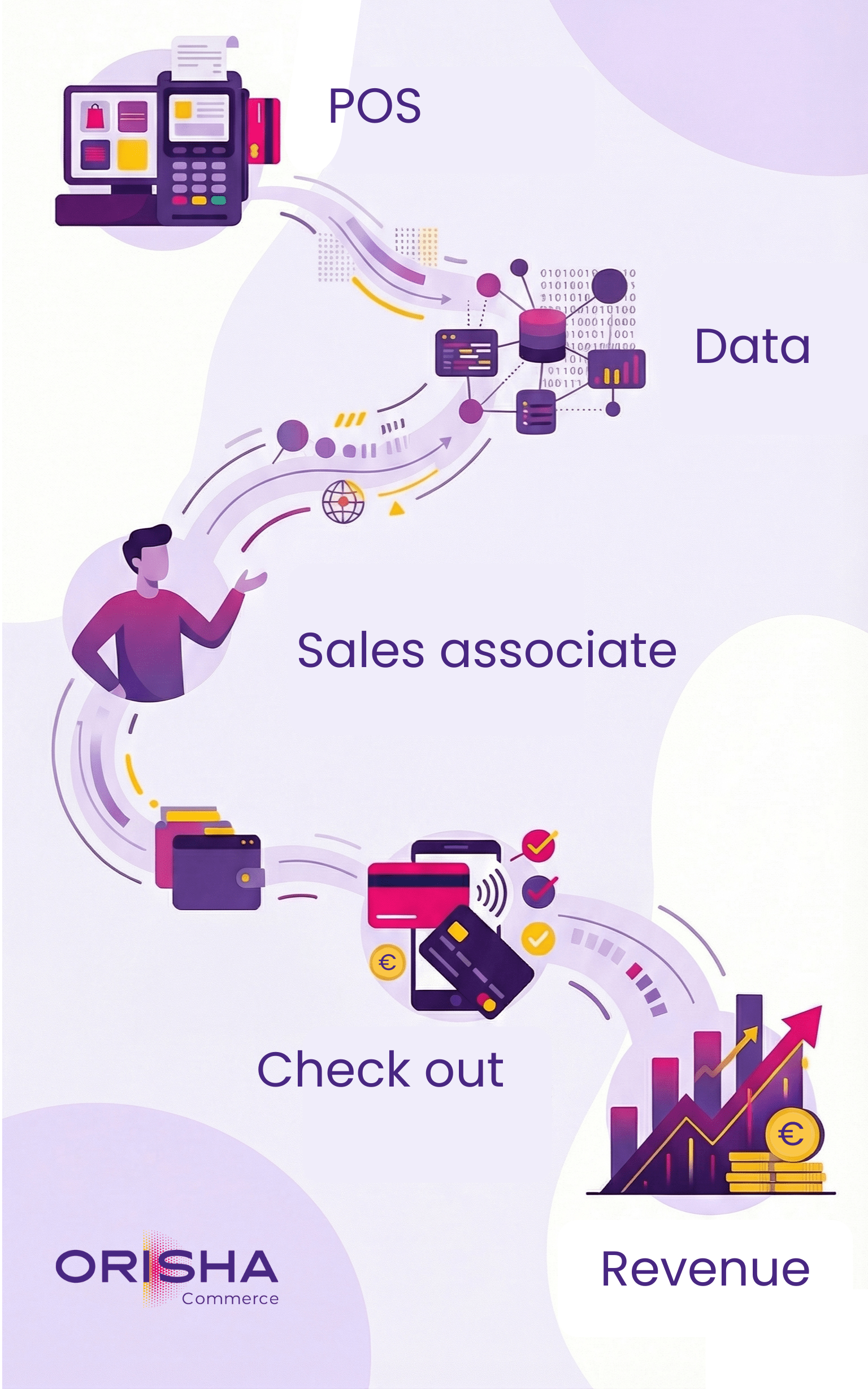
The omnichannel journey that sells
eReservations allow customers to reserve an item online and try it in-store. The sales associate views the reservation directly on the POS and prepares the product in advance. This continuity boosts the conversion rate of visits generated by the digital channel.
Click & Collect and in-store appointments rely on the same logic: synchronizing the online promise with the in-store reality. Thanks to a POS connected to real-time stock visibility, teams know exactly what to prepare, turning the pickup moment into a sales opportunity.
Finally, combining Self-checkout (SCO) and Mobile POS opens up new performance possibilities. SCO handles standard transactions, while the mPOS enables sales associates to intervene immediately in the aisles. This setup lets customers choose their preferred checkout method, reducing the load on fixed registers and increasing overall conversion.
Growth levers and associated POS features
|
Lever |
Revenue Impact |
Associated POS Feature |
|
Queue reduction |
Increased conversion |
Mobile POS / SoftPOS |
|
Reliable product availability |
Secured sales |
Real-time stock visibility (ATP/ATS) |
|
Recommendations at checkout |
Increased basket size |
Recommendation engine / Cross-selling |
|
Bundles & grouped offers |
Increased UPT |
Configurable bundles |
|
Targeted coupons |
Reinforced basket |
Wallet / Omnichannel coupons |
|
Gift cards |
Recurring visits |
Unified gift card management |
|
Consistent promos |
Stabilized conversion |
Centralized discounts and promotions engine |
|
Controlled returns |
Protected margin |
Returns / Refunds at checkout / Fraud prevention |
|
Mobile payment |
Peak absorption |
Mobile POS / SoftPOS / Unified payments |
Measurement & piloting
A unified commerce POS ensures precise tracking of the impact of in-store initiatives. Conversion rate optimization metrics, average basket size, and UPT are accessible in real-time, store by store, allowing you to identify effective drivers.
Measuring checkout speed (TPS) and the percentage of mobile payments also helps evaluate journey fluidity. A high rate of mobile transactions indicates that sales associates are actively using conversion support tools.
Finally, tracking payment acceptance and return rates completes the picture. Payment refusals reveal issues with terminals or banking rules, while Returns / Refunds analysis helps detect anomalies.
Quick wins in 30 days
- Launch a pilot Mobile POS line to absorb peak traffic.
- Deploy a targeted promotion rule to increase average basket size.
- Activate a stock availability widget at checkout to secure sales.
- Optimize the Click & Collect journey to reduce pickup times.
The Point of sale (POS) is a direct driver of commercial performance. It improves conversion, basket size, visit frequency, and margins. For retailers, it is an investment that transforms the checkout into a growth engine.

FAQ
How does a POS influence in-store conversion?
The POS impacts conversion by smoothing the checkout experience and removing friction points. With Mobile POS or SoftPOS, sales associates can process payments anywhere in the store, reducing abandonment due to queues. The POS also provides immediate real-time stock visibility.
Which POS features increase basket size/UPT?
Recommendations integrated into the POS (complementary products, alternatives, bundles) allow it to immediately propose relevant options. Centralized management of coupons, discounts and promotions, and benefits also facilitates adding items or offers without complicating the checkout process.
How to measure POS impact on revenue (KPIs/ROI)?
-The in-store conversion rate optimization metrics show if the POS genuinely streamlines checkout.
-Average basket size and UPT help evaluate the effectiveness of recommendations, coupons, and bundles proposed at checkout.
-Checkout speed (TPS) and Mobile POS usage rates measure the capacity to absorb traffic peaks.
-The payment acceptance rate reveals invisible losses linked to failed transactions.
-Analysis of Returns / Refunds and sales refusals helps estimate margin gains.
POS, mPOS, SoftPOS: Which to choose for my store format?
– A fixed Point of sale (POS) is best suited for high-traffic stores organized around a specific checkout zone, ensuring stability, speed, and high transaction volume.
–Mobile POS fits formats focusing on in-aisle assistance, such as fashion, beauty, concept stores, or premium boutiques where the sales associate plays a key role in conversion.
-SoftPOS is ideal for small formats, corners, pop-up stores, or event zones, as it transforms a simple smartphone into a payment terminal without dedicated hardware.