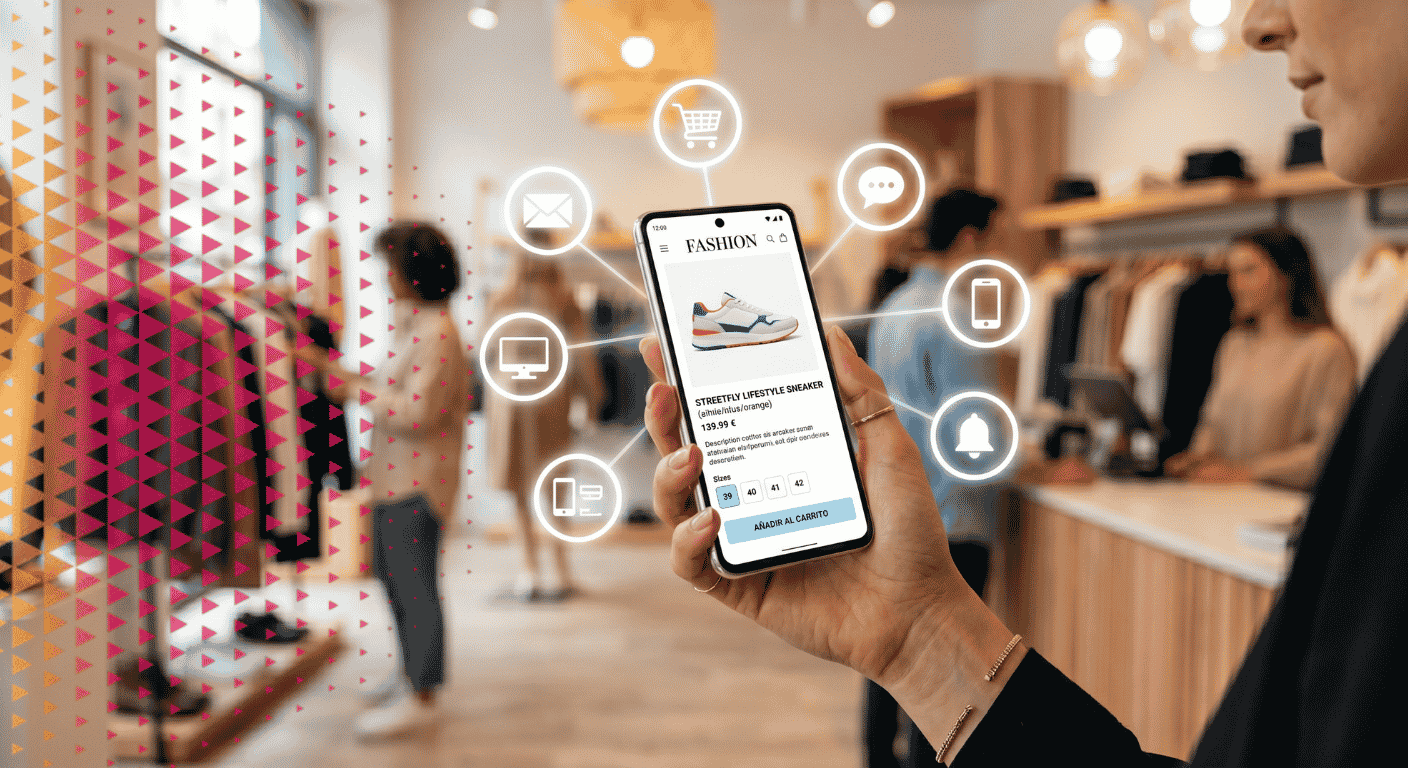


Web-to-store: 7 levers to drive customers back in-store

In 2025, physical retail is evolving under pressure. While store footfall is declining, expectations regarding speed, pricing, and social responsibility are skyrocketing. In this context, the physical store remains central to the customer experience, brand differentiation, and margins.
To continue attracting visitors, the point of sale (POS) must be fueled by controlled digital acquisition and supported by a unified commerce strategy. Web-to-store, POS, eCommerce, OMS, and data determine retail’s ability to drive customers back in-store.
Web-to-store, drive-to-store, ROPO: What are we talking about in 2025?
Web-to-store refers to all digital actions that trigger a customer visit to the store:
- Product research online;
- Local pages, specifically Google My Business;
- Available inventory checks;
- eReservations;
- Personalized offers.
Drive-to-store, on the other hand, relies on advertising (e.g., local search, geolocated social ads, SMS, notifications) to incentivize travel to a specific point of sale. Finally, ROPO (Research Online, Purchase Offline) describes a behavior: consumers gather information online, then make their purchases on-site.
For retail leaders, “basic” omnichannel is now table stakes: Click & Collect, eReservations, store web pages, and visible stock. The differentiator now lies elsewhere:
- Traffic quality: The goal is no longer just to increase visit volume via marketing, but to attract relevant customers.
- Keeping the service promise: A poorly synchronized web-to-store journey such as inaccurate stock accuracy destroys consumer trust. Every digital interaction creates an expectation that the store must be able to honor.
- Data-driven steering: Local internet searches (especially Google), purchase intentions, omnichannel journey histories, and footfall data are web-to-store signals that must be leveraged. Coupled with AI forecasting, they allow retailers to anticipate demand and adjust stock.
Web-to-store is a high-performance approach when part of a unified strategy: a shared view of the customer, stock, and service across the web, CRM, POS, and management tools.
Phygital as a traffic engine
Corners & partnerships as traffic magnets
In 2025, the store has once again become a media channel in its own right, as illustrated by the Shein corner at BHV. In just a few days, the operation attracted nearly 50,000 visitors. Beyond the opinions and controversies, Shein’s strategy demonstrates that a targeted corner, backed by a brand with high online awareness, acts as a traffic accelerator for a department store.
- The shop becomes a temporary physical showcase for digital-native brands;
- The physical establishment serves as a hub for trying on items and providing reassurance;
- “Event-izing” the space creates an urgency to visit that is difficult to replicate online for a pure-player brand.
Corners and partnerships have become web-to-store tools capable of bringing back customers who had abandoned the physical point of sale for their purchases, while capturing new audiences via the partner’s online reputation.
Halo effect: When one universe drives another
The halo effect is based on the premise that an attractive universe can activate others. In the case of BHV and the Shein corner, 15% of visitors who came specifically for the Shein brand subsequently made purchases in other areas of the establishment.
This strategy applies to various sectors:
- Fashion & Luxury: A second-hand or premium refurbished corner attracts a younger or more socially engaged clientele, who then discover the permanent collections.
- Sport: A product testing space, an augmented fitting zone, or a customization workshop generates traffic that converts into complementary sales.
- Home & Equipment: A guest brand, a capsule collaboration, or a diagnostic service triggers a visit that extends beyond the initial offer.
The halo effect is measurable by cross-referencing information from the POS software and the CRM:
- Evolution of the average basket of visitors exposed to the corner;
- Cross-selling rates between universes;
- Time spent in-store and number of zones visited;
- Medium-term repurchase rates following a first visit triggered by the event.
Event & service effect: Giving a reason to travel
Various events can be activated in-store:
- “Same day” Click & Collect days, promising immediate in-boutique availability;
- Repair workshops, upcycling, or customization, which add value to product lifespans;
- Sports sessions, coaching, or demonstrations hosted by experts or partners.
The digital channel plays a major role upstream to create the intention to visit, but also downstream to extend the relationship.
A powerful lever is second-hand campaigns offering a voucher credited to the customer account, similar to Back Market. Depositing a product in the boutique triggers an immediate benefit, reusable on-site or online
7 priority web-to-store levers for 2025
1. Local visibility & “Near me” searches
The first gateway to the boutique is local search. Queries like “near me,” “available today,” or “immediate pickup” translate a strong consumer intention. If the information is unclear or outdated, the customer turns to another retailer.
The baseline is now non-negotiable:
- Complete and up-to-date store listings, especially Google My Business;
- Store locator with geolocation and filtering by service;
- Visible customer reviews;
- Highlighting of services available in the boutique.
A robust link between eCommerce and the core suite is indispensable for synchronized stock and information.
2. Making stock and services visible in real-time
In a web-to-store strategy, the decisive piece of information is real availability. Concretely, the retailer must display:
- In-boutique stock directly on the product catalog;
- Available inventory by point of sale;
- Locally activate services.
This promise is made possible thanks to unified stock, managed via an OMS connected to inventory management tools.
3. Streamlining the Web → Store transition: Click & Collect, eReservations, Drive…
The transition from digital channel to store must be immediate and effortless. Click & Collect, eReservations, or drive-throughs are standards expected by customers. The key role belongs to the OMS:
- It centralizes orders and stocks from all channels;
- It automatically selects the best preparation point based on rules regarding time, costs, or availability;
- It pilots web-to-store scenarios;
- It manages omnichannel returns / refunds.
In mature unified commerce strategies, hybrid journeys account for more than 50% of online orders.
4. Equipping teams: mPOS, Clienteling & Unified Data
Combining mobile POS + clienteling, connected to unified data, transforms the role of the sales associate. They become capable of:
- Identifying the customer from the start of the interaction;
- Accessing the basket or intentions derived from digital activity;
- Processing payments anywhere in the boutique;
- Managing a return as a continuation of the journey.
Retailers like Decathlon or Intersport have already implemented this strategy at scale: a fluid omnichannel journey, RFID for inventory management and assisted sale, and self-checkout to absorb traffic peaks.
5. Personalization and loyalty to drive returns
The challenge of a web-to-store strategy is to create a cycle of visits by relying on personalization and omnichannel consumer loyalty. Loyalty programs rely on a unified view of the customer, capable of rewarding purchases both online and in-store. Benefits are triggered based on the journey to optimize the customer relationship.
The power of web-to-store also lies in leveraging consumer intent signals, which trigger automated marketing campaigns:
- Repeated viewing of a product;
- Add-to-cart without conversion;
- Booking or abandoning an appointment;
- Unfinalized reservations.
6. ReCommerce, Repair, Services: The store as a circular hub
In a ReCommerce strategy, the physical establishment plays a central role:
- The POS records the repurchase or deposit of the product at the point of sale;
- The OMS orchestrates flows between stores, warehouses, and refurbishment partners;
- The CRM preserves the history of interactions and fuels loyalty mechanics.
Second-hand trade, repair, or trade-ins become reasons for recurring visits (product deposit, return, refurbishment). Each step is an opportunity for contact with the consumer and additional sales.
7. Steering web-to-store via KPIs
To steer a web-to-store strategy, retailers must cross-reference two families of performance indicators.
On the web side, to qualify intention:
- Click-through rate on store listings and product pages;
- Share of Click & Collect and eReservations;
- ROAS of drive-to-store campaigns;
- Web-to-store signals.
On the store side, to measure real impact:
- Evolution of traffic at the point of sale;
- Conversion rate optimization of consumers exposed to web-to-store;
- Average basket and additional sales;
- Halo effect between universes.
This strategy relies on unified data sources: POS and mPOS in-store, OMS for order flows, CRM for customer knowledge, and the eCommerce platform for intent signals. By cross-referencing store and web-to-store indicators, retailers guarantee the arbitration of marketing investments and the optimization of purchasing journeys.
POS + eCommerce + OMS: The technical foundation of profitable web-to-store
The POS is the new generation of POS software. Associated with mPOS, they allow retailers to:
- Capture sales, traffic, and consumer interactions at the point of sale;
- Process payments anywhere and streamline the experience;
- Transform the store into an omnichannel hub.
eCommerce and the core suite play the role of acquisition engine and digital orchestration. They centralize:
- The product catalog and services;
- Experience personalization;
- Web-to-store entry points.
The OMS and order management solutions ensure operational continuity:
- Orchestrating Click & Collect, Ship from Store, and the endless aisle;
- Selecting the best preparation point;
- Guaranteeing the customer promise regarding timeframes and availability.
To go further: Download our free guide on selecting POS software for unified commerce.
Where to start? 5 priority projects
1. Map existing web-to-store journeys and KPIsBefore optimizing, you must identify existing journeys (e.g., local search, Click & Collect, reservation, returns) and associated indicators to spot friction points.
2. Unify stock view via an OMS and unified management toolsThe operational priority is stock reliability. Centralizing data and orchestrating flows via an OMS secures high-business-impact scenarios: Click & Collect and eReservations.
3. Deploy a first “clean” web-to-store funnelIt is better to have one simple, reliable journey than a multitude of fragile scenarios. A specific day (D+0) or next day (D+1) Click & Collect, with a clear commitment on timing, constitutes a solid base for generating qualified in-store traffic.
4. Equip one or two pilot stores with mPOS and ClientelingTesting on a reduced scale allows you to quickly measure the impact on conversion, average basket size, and the halo effect. mPOS and clienteling in-store give teams the means to absorb web-to-store traffic without degrading the experience.
5. Implement a unified web-to-store dashboardSteering relies on crossed data: store traffic, conversion rates, halo effects, and loyalty. By consolidating data from the POS, mPOS, OMS, and eCommerce, web-to-store becomes a measurable lever.
Driving customers back to the store is the result of alignment between digital acquisition, service promises, and operational execution. Web-to-store works when it attracts qualified and expected traffic to the point of sale.
Retail leaders have turned the store into an omnichannel hub, connected to a unified platform. The solution is capable of orchestrating stock, product, and customer data. The physical point of sale becomes a strategic advantage once again for generating value and loyalty
- Web-to-store relies on a unified POS + eCommerce + OMS architecture to fulfill the customer promise in-store.
- Retail leaders combine phygital strategies, events, second-hand options, mobile POS (mPOS), clienteling, and loyalty programs to create reasons for recurring visits and measure the halo effect.
- Performance depends on cross-monitoring digital and store indicators, as well as standardized omnichannel journeys, made possible by unified data utilization.
Frequently asked questions
What is a web-to-store strategy?
A web-to-store strategy consists of mobilizing all touchpoints (e.g., local SEO, campaigns, social media, online product reservation) to transform online intent into qualified visits. The challenge in 2025 is no longer just to attract, but to convert and retain customers thanks to a unified POS + eCommerce + OMS architecture.
What is the difference between web-to-store and drive-to-store?
- Web-to-store relies mainly on digital touchpoints (e.g., website, app, social networks, and email) to trigger a store visit. Drive-to-store encompasses more broadly all actions that push the consumer to travel (print, radio, billboards, local promotion), with digital being just one channel among others.
Why is the POS central to a web-to-store strategy?
- The POS records sales and consumer interactions in-store. It is the source of operational information for retailers to measure the impact of digital actions on traffic, basket size, and the halo effect. Coupled with an mPOS and an OMS for centralized inventory management, this tool also allows for the execution of Click & Collect, Ship from Store, and omnichannel return journeys without disruption.
How to measure the effectiveness of a web-to-store strategy?
Key KPIs include: store traffic from digital campaigns, Click & Collect rates, in-store conversion of identified web-to-store customers, average basket, halo effect (additional purchases), repurchase rates, and CLV (Customer Lifetime Value). These indicators are built by cross-referencing eCommerce, POS/mPOS, OMS, and CRM data.
What are some examples of successful web-to-store strategies among retail leaders?
- Decathlon: Web-to-store + RFID + self-checkout to streamline the customer experience and reduce checkout time.
- Intersport: Centralized OMS to optimize product availability.
BHV x Shein: A corner highly attractive for traffic, generating a halo effect toward other departments of the establishment (along with all the image challenges associated with the Shein brand).
How do social networks and Google concretely contribute to an effective web-to-store strategy?
Social networks and Google intervene upstream in the journey. On the Google side, local search, establishment information sheets, and customer reviews constitute a reassurance lever. The store locator then allows the user to be directed to the right point of sale. The advantage is capturing an already qualified intention and reducing friction.
Social networks reinforce store visibility. Integrated into a marketing approach, they serve to trigger desire, then redirect to concrete entry points (store listing, locator, reservation). By combining Google, customer reviews, and store locators, web-to-store becomes a profitable acquisition lever.