


Customer service chatbots: why voice assistants are becoming essential in 2025

TL;DR: Customer service chatbots and voice assistants in 2025
- Voice remains a critical channel for retail customer service;
- Chatbots and callbots can automate up to 80-85% of simple support requests;
- Their value hinges on integration with the CRM, POS software, OMS, and unified customer data;
- The goal is not to replace advisors with conversational agents, but to refocus them on high-value cases;
- A unified commerce platform like Orisha transforms bots into a powerful conversational front end for customer service.
Conversational AI is currently experiencing a massive surge. From chatbots to callbots, these agents are proliferating and profoundly reshaping the customer service landscape. Today’s consumers expect immediate, 24/7 responses across every touchpoint, whether via phone, chat, or social media.
However, many conversational agents fail to deliver on their promises due to a lack of integration with core business systems, leading to inaccurate information and fragmented journeys. Unified commerce provides the robust, centralized data foundation required to ensure a truly seamless experience.
Customer service chatbots: the current landscape
Defining chatbots, voicebots, callbots, and voice assistants
Automated assistance now encompasses several complementary technologies within customer relations. A chatbot refers to a text-based conversational agent integrated into websites, mobile apps, or social media messaging. It handles routine support requests and gathers the necessary data to speed up processing for human teams.
Voicebots rely on vocal interactions, typically through dedicated apps or smart speakers. They handle more spontaneous queries, making them ideal for quick tasks or users on the move.
Callbots operate directly on the telephone channel, either preceding or complementing an IVR system. They streamline call handling, execute simple tasks, and reduce wait times before a customer reaches a human advisor.
Finally, mainstream voice assistants like Alexa are playing an increasing role in customer service. These agents allow brands to offer direct access to information through simple voice commands.
The generative AI shift
The advent of generative AI has revolutionized the capabilities of customer service chatbots. Conversations are now more natural and better contextualized. Modern bots can understand diverse phrasing and maintain the thread of a conversation through multiple questions. This evolution also brings native multilingual proficiency.
Powered by AI, chatbots can now connect directly to business systems such as the CRM, OMS, and POS software. This enables them to answer specific questions such as:
- Where is my order?
- Is this item available in a specific store?
- What is the repair history of my product?
The callbot: a new pillar of omnichannel customer service
Why voice remains a critical channel in retail
For retail businesses, voice remains an essential touchpoint for situations requiring immediate resolution.
Companies receive a high volume of calls regarding operational queries:
- Order tracking;
- In-store availability;
- Curbside pickup issues;
- Repair workshop requests;
- Returns and after-sales service.
Customers remain deeply attached to phone conversations when dealing with high-stakes issues, such as urgent complaints, delivery delays, or critical blockers. In these moments, voice provides a sense of direct care, resolving ambiguities faster and clarifying complex contexts.
How a voice chatbot integrates into the journey
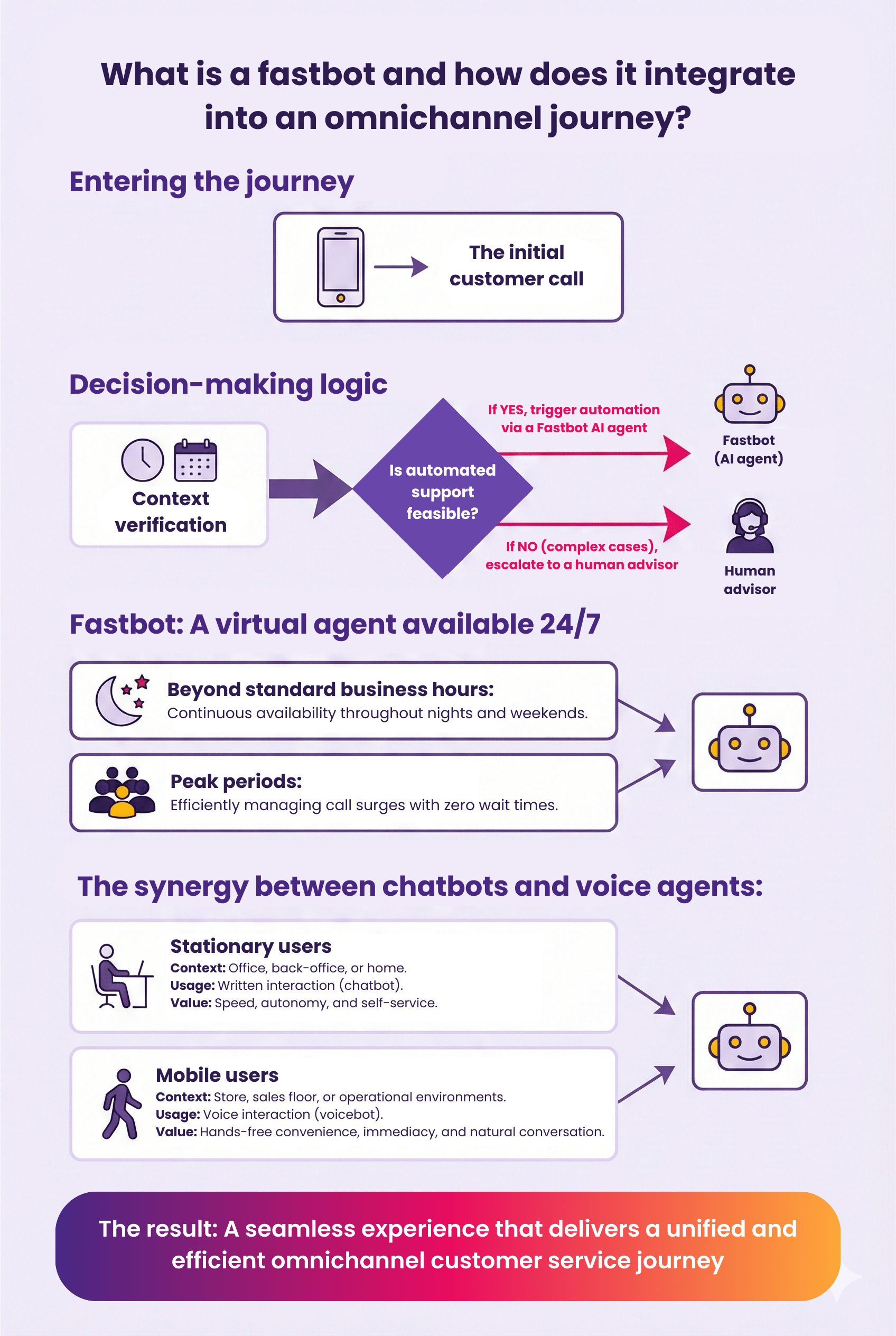
A voice chatbot enters the frame at the very first point of contact. The agent answers the call, identifies the intent using natural language understanding, and accurately qualifies the request.
Once the intent is detected, the bot offers self-service features that can immediately resolve a large portion of common support requests:
- Tracking or modifying an order;
- Checking store hours and peak times;
- Booking appointments for the repair workshop or after-sales service;
- Retrieving information about a product or service.
When a request requires human intervention, the chatbot ensures a seamless handoff to the right person. The advisor receives the full context reason for the call, relevant data, and history. This continuity makes it much easier for the employee to resolve the issue.
6 key benefits of voice chatbots in retail customer relations
1. 24/7 availability and reduced wait times
Voice chatbots provide continuous call handling, even outside traditional hours (evenings, weekends) or during peak activity. These agents absorb inbound traffic and slash wait times while maintaining a consistent level of service. Their availability improves the customer experience and frees up advisors for complex requests.
A DIY retailer, for instance, might see a massive surge in calls on Saturday mornings regarding product availability and workshop schedules. A callbot can automatically handle these queries in seconds. Meanwhile, human advisors can focus on cases that require specialized guidance.
2. Intelligent request pre-qualification
Using natural language understanding, voice chatbots quickly identify the reason for a call and collect vital information (order numbers, specific store locations, request types). This ensures the call is routed to the correct department immediately. The customer saves time, and the advisor has full context from the start.
In an appliance store, the bot automatically asks for the order number and detects that the call concerns a delivery delay. It routes the call to the logistics hub with all collected data. The advisor can then respond directly without having to re-enter information.
3. Personalization through unified data
Connected to core systems (CRM, POS software, OMS), a voice chatbot can instantly identify a customer and access their history:
- Current orders;
- Loyalty program status;
- Previous interactions;
- Declared preferences.
This consolidated view enables personalized responses (such as available delivery options or in-store exchange possibilities) and a much smoother experience.
A customer calls to track a clothing order. The bot recognizes her via her number, checks the OMS, and explains that the package is being prepared with an early pickup option. It also suggests using her loyalty points for a future order, based on CRM data.
4. Voice-to-digital continuity in an omnichannel strategy
When a customer calls, the bot acts as a natural bridge to other digital channels. It can send a link to a web journey to finalize an action, provide an SMS confirmation, or email a summary of the exchange. All interactions with the conversational agent are logged in the CRM, fueling future marketing efforts and clienteling initiatives.
If a customer calls to book an appointment, the chatbot suggests available slots and sends an SMS confirmation with a calendar invite. The interaction is recorded in the CRM, triggering a reminder before the appointment and a follow-up campaign afterward.
5. Relieving team workload and elevating advisor value
By automating up to 80-85% of simple requests (order tracking, hours of operation, FAQs), voice chatbots absorb the bulk of inbound traffic. This allows teams to refocus on situations requiring expertise and empathy, such as disputes, complex sales, and upselling.
In the furniture sector, many calls concern Click & Collect availability. The callbot handles these queries automatically and informs the customer in real time. Advisors, now less overwhelmed, can concentrate on complex after-sales service issues.
6. Driving strategic decisions through conversational data
Every interaction handled by a voice chatbot generates data on real customer needs: call reasons, abandonment rates, recurring issues, dissatisfaction signals, and average resolution times.
By centralizing bot insights, companies can adjust their assortment management, optimize logistics, refine staffing during critical hours, and adapt training programs. The bot thus evolves into a tool for both loyalty and strategic decision-making.
A sporting goods chain might notice a sudden spike in calls regarding a specific shoe model. This data alerts the team to an imminent stockout. Shipping is accelerated, and quantities are adjusted. Simultaneously, customer service enhances team training to offer relevant alternatives.
Chatbots and advisors: orchestrating without replacing humans
Conversational AI is not designed to phase out customer service teams. Instead, it acts as a co-pilot that streamlines exchanges and supports the work of human advisors.
The ideal organizational structure relies on orchestration. Bots (chat and voice) handle the initial tier of interactions and enrich customer files by collecting data. Advisors then take over for complex cases, supported by a unified view of the customer.
This model also allows companies to strengthen other levers like clienteling, customer relations, and loyalty programs, all of which benefit from richer, more accurate data.
Why a unified commerce platform is a game changer
Without a unified foundation, a bot’s potential is capped; it offers generic answers, approximate information, and cannot verify real-time inventory or delivery dates. This type of chatbot quickly becomes a disconnected gadget and a source of frustration.
With a unified commerce solution like Openbravo Commerce Cloud, the bot accesses every element of the omnichannel journey in real time:
- Unified inventory across stores, warehouses, and partners;
- Orders from the website, marketplaces, and physical stores;
- Customer profiles, loyalty program levels, and preferences;
- After-sales and repair workshop history, integrated through in-store and repair workshop solutions.
This architecture transforms chatbots and voice agents into a conversational front end, directly linked to unified commerce. They can execute reliable business actions that are fully consistent with operational decisions.
A customer calls regarding a bike issue. The chatbot instantly identifies their profile, checks the order, verifies the status in Openbravo Repair & Workshop, and suggests the first available slot for a store drop-off. It then sends an SMS confirmation. All this happens without human intervention, using 100% accurate data.
Where to start: 5 steps to launching a customer service chatbot
1. Prioritize 2–3 high-volume use cases
Start by targeting the most frequent and standardized requests: order tracking, store information, or booking appointments. These cases meet immediate needs and guarantee a fast ROI by reducing the volume handled by advisors.
2. Map out the systems to be connected
A chatbot’s relevance depends on its access to data. You must identify which systems to connect (CRM, OMS, POS software, WMS, or e-commerce platform). This mapping clarifies what information is needed to activate specific business scenarios.
3. Define escalation rules for human agents
An effective chatbot knows its limits. It is vital to define when a request should be transferred to a human based on the type of query, detected frustration levels, or the availability of your staff.
4. Train your teams
Advisors must learn how to pick up a conversation started by a bot and leverage the data generated during the exchange. This helps them adapt their approach and understand their evolving role.
5. Measure and improve continuously
Once live, track these key indicators:
- Resolution rate;
- Post-contact NPS;
- Average handling time;
- Impact on churn.
These insights allow you to adjust scenarios and steadily improve both service performance and the customer experience.
The rise of voice agents and chatbots marks a new milestone in retail customer service transformation. However, their true potential only emerges when connected to a unified commerce platform. With a centralized foundation, these tools become intelligent entry points capable of executing real-time actions and fostering a more consistent relationship.
Frequently asked questions
What is a customer service chatbot?
A customer service chatbot is a conversational agent that automatically responds to customer queries across various channels (website, messaging, phone). When connected to business systems (CRM, POS software, OMS), it provides personalized answers, tracks cases, initiates orders, or routes the customer to the right contact.(CM.com)
What is the difference between a chatbot, voicebot, and callbot?
-
- – A chatbot communicates via text;
- – A voicebot manages vocal conversations;
- – A callbot is a voicebot connected to the telephone channel and IVR, often used to filter and process inbound calls.
All of them rely on conversational AI to understand and respond to requests.(Egc-bs)
What are the main benefits of a voice chatbot for a retail company?
A chatbot offers 24/7 availability, reduces wait times, pre-qualifies requests, and automates simple questions. Linked to unified customer data, it personalizes responses for a better experience and frees up time for advisors to focus on complex situations. (Relationclient Mag)
Will voice chatbots replace human advisors?
No. In mature organizations, chatbots and callbots handle repetitive tasks and high volumes, while advisors remain essential for empathy, negotiation, and sensitive situations. The goal is to orchestrate a hybrid “bot + human” model rather than substituting one for the other. (Le Monde)
What data does a customer service chatbot need to be effective?
The bot needs access to a unified customer view: purchase history, pending orders, previous interactions, loyalty points, and after-sales tickets, as well as the company’s real-time inventory and logistics timelines. The reliability of the chatbot rests on a unified commerce platform’s ability to centralize this information.(Orisha Commerce)