


How to reduce product out-of-stocks in-store

We’ve all been there: a customer walks in with a smile, ready to buy their favorite product, only for you to have to say, “I’m sorry, we’re out of stock.” The smile fades, a sale is lost, and trust begins to erode. While this situation is frustrating, the good news is that the cause is often much closer to home and more controllable than you might think.
Effective inventory management in retail sometimes requires playing detective within your own four walls. In practice, many empty shelves aren’t caused by delivery delays, but by simple internal organizational issues. It’s like being certain there’s coffee left at home, only to discover the tin at the back of the cupboard has been empty for weeks.
So, what are the hidden causes of product unavailability lurking in your backroom? They generally fall into three main categories:
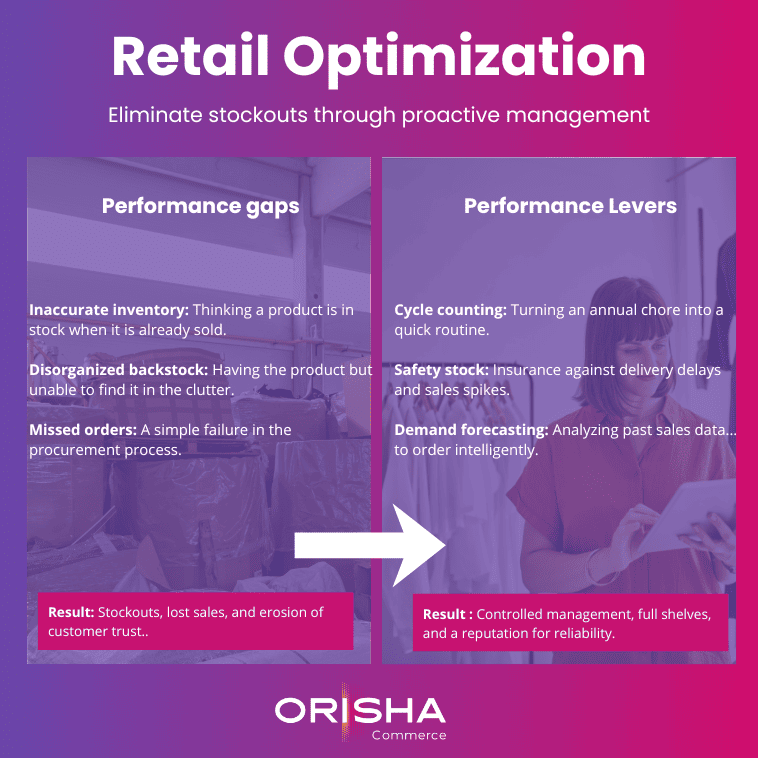
- Inaccurate inventory: Thinking a product is in stock when it has already been sold.
- Disorganized storage: Having the product but being unable to find it in the clutter.
- Ordering oversights: A simple lapse in the replenishment process.
Take the example of a bookseller who searches for a title for ten minutes, concludes it’s gone, only to find it a week later behind a stack of boxes. That’s a lost sale not due to a lack of store inventory, but a lack of organization. Fortunately, these are the easiest problems to fix.
Easy inventory: how to know what you actually have in stock
Does the mere thought of the annual inventory count give you cold sweats? Closing the shop, counting every single item for hours… it’s a massive undertaking, usually only done once a year. The problem is that, in the meantime, your stock takes on a life of its own. A checkout error in January, a damaged product in March, an incomplete delivery in May… By year-end, the gap between your theoretical stock and reality can be massive, leading to frequent out-of-stocks.
What if there was a simpler, more effective way? Forget the “spring cleaning” approach and think of it as regular maintenance instead. This is known as cycle counting. Rather than counting everything at once, you count a small portion of your stock on a very regular basis. For instance, on Monday you count Brand A; on Tuesday, Brand B, and so on.
To start this method, a simple notebook is all you need. Every day, pick a small product category. Physically count them and record the number, then compare it to your records or your POS software. In just fifteen minutes a day, you can turn an annual chore into a quick, painless routine. You’ll spot discrepancies almost in real-time, long before they result in an empty shelf.
The ultimate goal isn’t just counting for the sake of it; it’s about regaining control over your inventory. This real-time stock visibility gives you the confidence to know exactly when and how much to order, reducing the risk of overstocking or worse understocking. Once you know exactly what you have, you can determine the ideal amount to keep on hand for the unexpected.
Safety stock: your insurance against empty shelves
Knowing exactly what you have in stock is the first step. The second is determining the ideal quantity to keep so you’re never caught off guard. This is where the concept of “safety stock” comes in. Think of it like that extra tin of tomatoes or box of pasta you keep at the back of the pantry: it’s not for tonight’s dinner, but “just in case” surprise guests show up.
This extra buffer is your shield against two major issues: supplier delivery delays and unexpected sales spikes. A truck stuck in the snow, or a sudden surge in demand after a local blog post… without this small margin, your shelves empty instantly, leaving customers disappointed. Safety stock is one of the simplest and most effective ways to avoid empty shelves.
So, how do you calculate safety stock without getting lost in complex formulas? Simply observe your habits. For a product where you sell an average of 10 units per week, keeping 2 or 3 extra units at all times is an excellent starting point. This buffer representing 20% to 30% of your usual sales acts as an insurance policy with very low overhead.
This approach allows you to optimize inventory management at the point of sale (POS) with peace of mind. This comfort cushion absorbs daily fluctuations and ensures you almost always have something to sell. However, this safety net is a reaction to the unexpected. What if you could anticipate it instead?
Become your store’s meteorologist: anticipating customer demand
Having safety stock is like carrying an umbrella in your bag at all times. Anticipating demand is like checking the forecast before you leave the house. Instead of simply reacting to the unexpected, you learn to predict it. To do this, your best tool is your own history: your past sales.
Start by looking back. Your order books or POS software history are gold mines of information. Did you sell more ice cream during last July’s heatwave? How many bouquets were sold on Valentine’s Day? This basic customer data analysis to anticipate needs gives you a solid foundation. By identifying these seasonal trends, you turn vague intuition into a data-driven estimate.
The past informs, but the current context decides. A good meteorologist doesn’t just look at archives; they observe the current winds. Similarly, keep an eye on the local calendar: a neighborhood festival, a marathon blocking the street, or new offices opening nearby can completely change the game. By adjusting your orders based on these events, you can significantly improve your demand forecasting.
Adopting this proactive vision makes your supply chain strategies agile; in short, you order smarter, reducing the risk of costly surpluses or frustrating shortages. While this work can start with a simple notebook, modern tools can make it even simpler and more powerful without breaking the bank.
When technology becomes your ally (without breaking the bank)
If the idea of scouring old sales ledgers to play meteorologist sounds tedious, you’re not alone. Fortunately, technology can be your best assistant. A simple POS software system does the heavy lifting for you. Imagine a tool that remembers every sale and every product, never forgetting a thing. This isn’t a complex solution reserved for big chains; it’s an accessible ally for businesses of all sizes.
The principle is disarmingly simple: every time an item is sold, the system automatically deducts it from your inventory. Comparing manual vs. automated inventory management shows an immediate time saving. Better yet, the tool compiles this information for you. With just a few clicks, you can visualize your bestsellers or identify slow-moving stock. The benefits of inventory management software are clear: it provides reliable data to forecast demand with unmatched precision.
So, when is it time to make the switch? The right moment usually arrives when you’re spending more time counting products than advising customers, or when inventory errors become too frequent. Think of it not as an expense, but as an investment in optimizing your inventory management freeing up your energy for what really matters: creating a memorable customer experience for everyone who walks through your door.
Your action plan for shelves that stay stocked
That empty shelf that used to cause so much frustration is no longer an inevitability. You now have the keys to understanding why a product is missing and, more importantly, how to prevent it from happening again. This new perspective transforms a daily headache into a concrete opportunity to improve in-store availability.
To turn knowledge into action, here is your roadmap. Start tomorrow with these four steps for visible results:
- Conduct quick, regular cycle counts.
- Organize and label your backroom storage.
- Set safety stock levels for your key products.
- Anticipate sales spikes by checking your calendar and past sales data.
This challenge isn’t yours alone. Proper staff training on shelf management turns the fight against out-of-stocks into a collective effort. Explain to your team why every action matters and celebrate your successes together. Even simple logistic KPIs, such as the number of consecutive days a flagship product remains in stock, can become a shared source of motivation.
By applying these principles, you’re doing more than just filling shelves. You’re building a reputation for reliability, turning disappointed shoppers into loyal customers, and, above all, giving yourself the gift of stress-free management. You are no longer at the mercy of your inventory; you are the one in the driver’s seat.
FAQ : Mastering your stock and saying goodbye to empty shelv
Why are my shelves empty even though my suppliers are on time?
Most out-of-stocks aren’t caused by delivery trucks, but by internal organization. The three common culprits are inaccurate digital inventory, a backroom too cluttered to find products, or a simple ordering oversight. Before looking elsewhere, play detective in your own storage area.
What is "cycle counting" and why is it better?
Instead of closing the shop once a year for an exhausting count, cycle counting involves counting a small portion of your stock every day (e.g., Brand A on Monday, Brand B on Tuesday). With just 15 minutes of daily work, you spot errors in real-time and maintain an ultra-precise view of your shelves.
How do I easily calculate safety stock?
Safety stock is your “insurance” against the unexpected. To start without complex math, keep a buffer of 20% to 30% of your usual sales. If you sell 10 items a week, having 3 aside “just in case” helps absorb a demand spike or a delivery delay without disappointing the customer.
How can I anticipate customer demand without a crystal ball?
Become your store’s “meteorologist” by combining two sources:
- The past: Analyze your sales data from the previous year (seasonality, holidays).
Current context: Anticipate local events (roadworks, marathons, neighborhood festivals) that can radically change customer traffic.
When should I switch from a notebook to POS software?
The right time is when you’re spending more time counting products than advising customers. An automated POS software system deducts stock with every sale and alerts you when you reach a critical threshold, turning a business expense into an investment in peace of mind.