

Implementing second-hand in retail: apparel, sports, DIY – An operational guide
- Launching a second-hand strategy in retail isn’t something you can just wing.
- Success requires a well-defined business model, adapted in-store operations, a Unified commerce IT architecture, and a long-term focus on profitability.
- This guide breaks down the essential steps, strategic decisions, and best practices for deploying a high-performance, scalable second-hand offering.
Why structuring a second-hand offer has become strategic for retailers
Second-hand is no longer an experiment but a growth lever
For years, retailers treated second-hand as an experimental niche. Today, it has shifted into a core market driver, with volumes and stakes that rival traditional retail. According to Ifop (2025), 76% of French consumers have already participated in the pre-owned market by buying or selling used items.
Demand is growing steadily as consumers prioritize value without sacrificing quality standards. The pre-owned market captures a segment of customers who might otherwise walk away from a purchase. Furthermore, a second-hand offering allows brands to directly address growing environmental and ecological expectations.
Recommerce, store traffic, and loyalty: the expected benefits
A ReCommerce offering is a direct catalyst for both online and in-store traffic. Buy-back programs, in particular, give customers a reason to return to the Point of sale (POS) to drop off items, creating additional footfall and prime opportunities for cross-selling.
In terms of Loyalty, second-hand deepens the long-term relationship with the brand. By facilitating buy-backs, resales, or exchanges, retailers enrich the product lifecycle, staying relevant to the customer long after the initial transaction.
The risks of an unstructured approach
Inconsistent product quality, fluctuating prices, and opaque buy-back terms are friction points that quickly erode customer trust. Because sustainable and ethical consumption is such a sensitive topic, any gap between brand marketing and reality is heavily penalized by the market.
The risks are also financial miscalculating the Costs of sorting, quality control, reverse logistics, or refurbishment can quickly tank margins.
Ultimately, the operational complexity of the second-hand market is often underestimated.
This strategy demands
- new online and in-store workflows,
- distinct management rules,
- seamless coordination between marketing, IT, Supply chain, and in-store Sales associates.
Which second-hand models can be deployed in retail
Buy-back and resale of pre-owned products
The buy-back and resale model is straightforward: the retailer buys used items from customers, inspects them, and resells them under its own banner. This setup ensures the brand maintains total control over the Customer experience, pricing, and quality while leveraging established brand trust.
This model is ideal for retailers with a store network capable of handling intake and customer service, particularly in the fashion and accessories sectors.
Rental, repair, and refurbishment
Rental, repair, and refurbishment models focus on extending a product’s life rather than immediate resale. These are best suited for brands with high-value items or a strong service-oriented identity. These systems generate recurring revenue and position the brand as a key player in the circular economy.
Internalized models vs. specialized partnerships
In-housing the operation ensures the retailer controls every link in the chain: from the Customer experience and Pricing management to product quality and data analysis. While this is the best long-term play, it requires significant upfront investment in tools, talent, and organizational structure.
On the other hand, partnering with specialists allows for a rapid launch and mitigates operational risk. These partners provide turnkey solutions technology, reverse logistics, and refurbishment expertise in exchange for a share of the margin and a degree of brand dependence.
Which model for which sector
In fashion, the buy-back and resale of garments is the most common model. Fast collection cycles, standardized sizing, and high consumer demand make it relatively easy to implement buy-back programs.
Some fashion retailers have scaled their second-hand offerings successfully, such as Kiabi Group’s platform, Kidkanai. It allows customers to buy and sell children’s clothes, toys, and books within a brand-controlled ecosystem. The retailer uses Openbravo POS to orchestrate store operations and maintain a seamless Omnichannel journey.
In the sports sector, second-hand is driven by product durability and performance. Refurbishment, repair, and rental models are particularly well-suited for technical or seasonal gear. These models maximize product utility while bolstering the brand’s technical credibility.
Decathlon’s “Seconde Vie” (Second Life) initiative focuses on buying back and reselling sports equipment like bikes and apparel. The goal is twofold: extending product lifecycles and making sport more accessible to everyone.
In home improvement and DIY, rental and repair often take precedence over resale. Larger, non-standardized products make resale logistically complex. Instead, retailers find success through maintenance services, trade-in programs, or tool rentals.
Implementing second-hand: the key stages
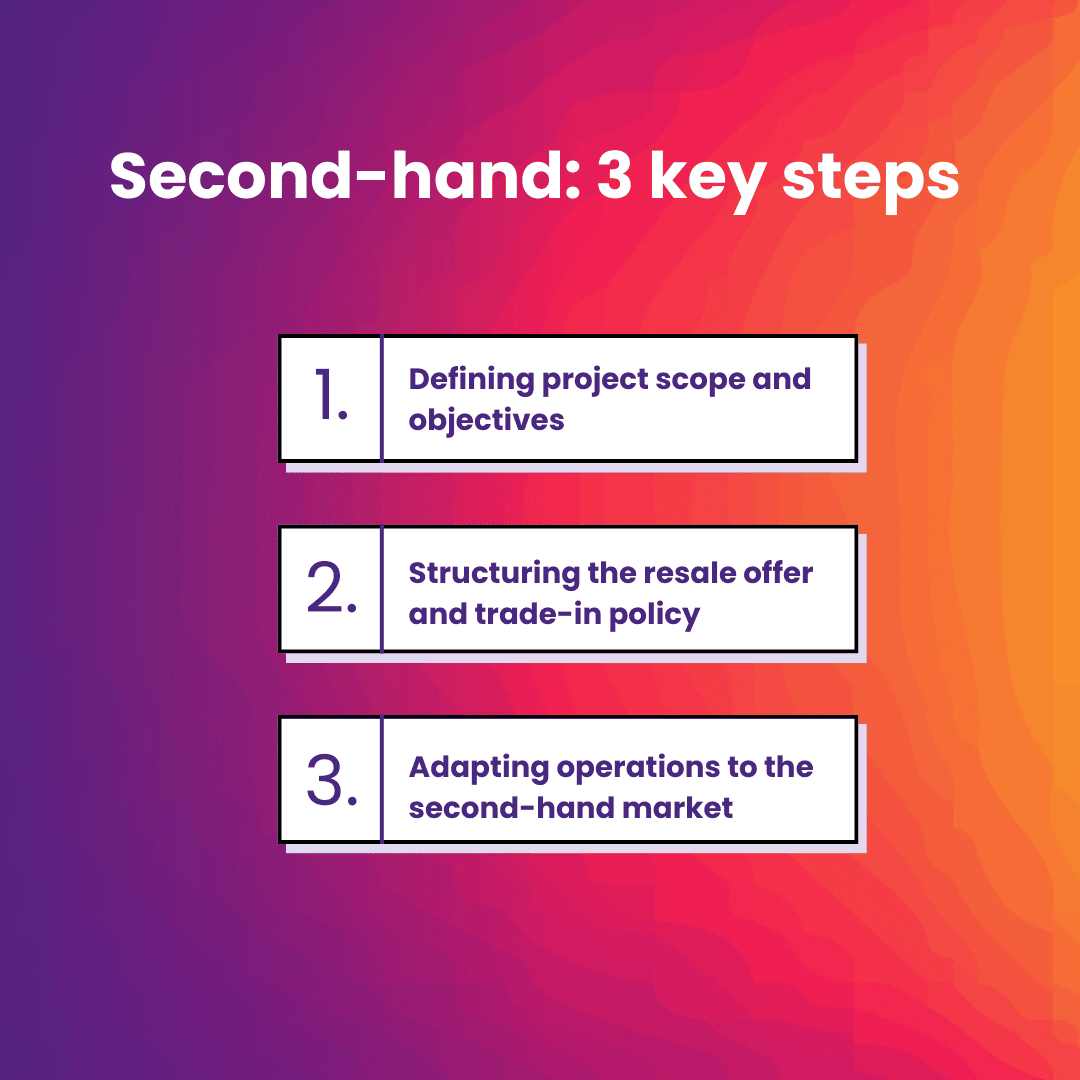
Defining the project scope and objectives
The first step is clarifying the strategic role second-hand will play for the brand. Is the primary goal to drive store or online traffic? To boost Loyalty? Or to advance brand image and CSR commitments?
Every decision directly affects the complexity and profitability of the pre-owned offering. Key factors include:
- The product ranges involved;
- The online and offline channels activated;
- Geographic scope;
- Target customer personas.
Structuring the pre-owned offer and buy-back rules
Structuring a pre-owned offer starts with clear acceptance criteria:
- Eligible categories,
- Required condition,
- Accepted brands or Product references,
- Limits of wear and tear.
- These rules must be simple enough for staff to apply consistently.
Quality control is what bridges the gap between the brand promise and the product on the shelf. Whether handled in-store, at a central hub, or by a partner, it must rely on standardized evaluation grids and pricing models.
Your Pricing management and buy-back policy will dictate the project’s financial health. The offer to the customer must be perceived as fair, yet it must account for the Costs of sorting, refurbishing, and reselling.
Adapting the organization to the pre-owned market
Entering the second-hand market changes the role of the in-store Sales associate. Evaluating used items and managing inbound inventory are new tasks that must be integrated into existing workflows. Clearly defining these new responsibilities is vital.
Furthermore, training is the most important lever for successful adoption. Staff need to master new operating procedures and adjust their customer interactions. The impact on their overall workload must also be realistically assessed beforehand.
Store organization and processes for second-hand
Flow management: buy-back, sorting, storage, and resale
The success of a pre-owned offer depends on flow efficiency. The buy-back process should be treated as a distinct customer journey, with clearly marked entry points and optimized processing times.
Sorting can happen immediately at the Point of sale (POS) or be deferred to a back-office area. The goal is to route each product to the correct channel as quickly as possible. Standardization at this stage is the best way to reduce friction.
Storage and resale must be integrated within the existing constraints of the sales point, particularly regarding dedicated space. Clear flow organization boosts efficiency and makes pre-owned items more appealing to customers.
Impact on teams and change management
Introducing second-hand operations brings new tasks and unfamiliar evaluation criteria, which can disrupt established routines. Naturally, this can lead to some resistance from the workforce.
Effective change management starts with transparency. Sales associates need to understand the “why” behind the second-hand strategy. Providing them with simple processes and the right tools is the fastest way to gain their buy-in.
Standardization vs. local flexibility in a store network
For any retail chain, standardization is non-negotiable for a consistent Customer experience and network-wide performance tracking. Buy-back rules and quality standards must be uniform across all locations.
However, being too rigid can backfire. Volumes, customer profiles, and space constraints vary by location. Allowing for a degree of local flexibility ensures the program remains practical and effective on the ground.
Tools and IT architecture to drive second-hand
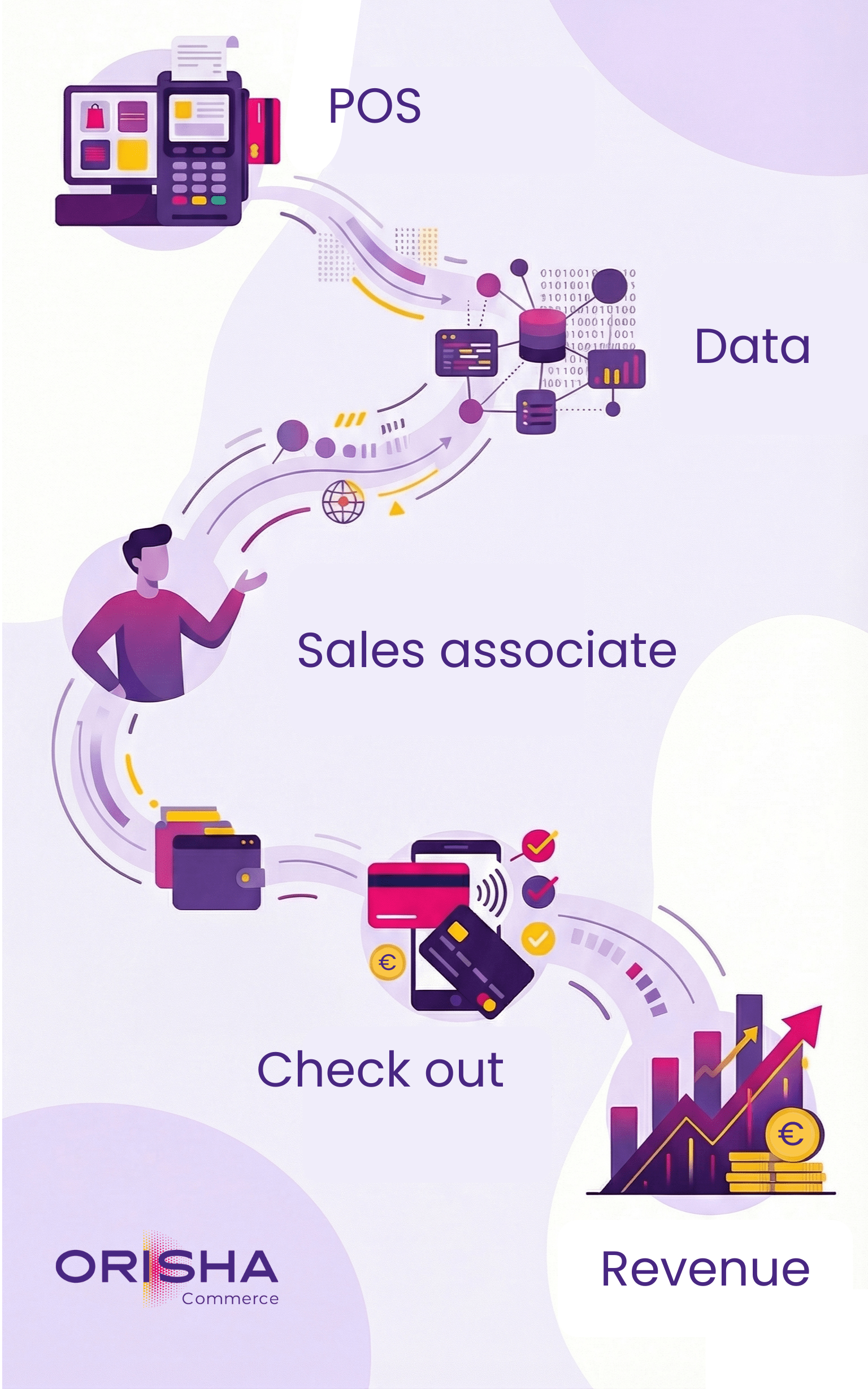
The central role of the POS in a ReCommerce strategy
In a ReCommerce strategy, the POS is the engine that manages in-store buy-backs, enforces eligibility rules, calculates payouts automatically, and triggers the appropriate customer rewards.
The POS software provides granular product traceability through synchronized data flows. This Real-time stock visibility ensures total consistency across every channel.
Integration with existing systems (inventory, CRM, OMS)
Second-hand must integrate natively with existing systems, starting with Inventory management. Pre-owned items follow unique rules regarding condition and lifecycle that require specific Product references. It is also critical to maintain a clear distinction between new and used inventory flows.
Furthermore, buy-back and resale activities generate a wealth of data on customer behavior. Linking this data to your CRM is a powerful way to drive Personalization in the customer journey.
Finally, the OMS (Order Management System) is vital for orchestrating the Omnichannel journey, managing resale based on product location, availability, and the chosen distribution channel.
Performance tracking and real-time management
Managing a second-hand operation requires specific KPIs:
- Buy-back rates;
- Acceptance rates;
- Inventory turnover for used goods;
- Time-to-resale;
- Overall margin contribution.
Real-time monitoring allows for rapid adjustments on the ground essential if buy-back volumes spike or inventory becomes unbalanced. This agility keeps Costs in check while maintaining a Seamless experience for the customer.
Scalability and future-proofing
Second-hand must be built for Scalability. A model that works in a few pilot stores can easily break if it wasn’t designed to handle higher volumes. True Scalability depends on standardized processes and an IT architecture capable of scaling up on demand.
The system must be able to adapt based on real-world usage and feedback without requiring a total overhaul:
- Gradual integration of new services (repair, rental);
- Opening new channels;
- Adjusting buy-back and pricing policies.
This requires modular tools and fluid connections between various IT components.
Want to connect recommerce services without a full IT overhaul?
Profitability: securing the business model
The main costs to anticipate
Operationally, the Costs associated with sorting, quality control, refurbishing, and flow management are often underestimated. Each step adds processing time and requires rigorous oversight.
Second-hand logistics create additional overhead compared to traditional retail, specifically regarding in-store collection, transit to specialized hubs, dedicated storage, and redistribution.
IT and HR Costs complete the equation. Adapting legacy systems and integrating new components requires sustained investment. On the HR side, team training and the time allocated to second-hand operations must be factored into the economic model.
Profitability levers in the pre-owned market
Inventory turnover is the primary lever for profitability in second-hand. The shorter the window between buy-back and resale, the lower your storage and management Costs. This requires rapid sorting, effective listing, and high visibility for the offer.
Moreover, buy-backs can serve as a gateway to new product sales, particularly when using store credit. Second-hand attracts budget-conscious shoppers who might not have bought new, then provides a path to upsell them into premium ranges. This synergy boosts overall revenue.
Finally, by integrating second-hand into your loyalty program or CRM, you increase visit frequency and customer lifetime value. Buy-back incentives and personalized benefits create long-term Loyalty.
Key KPIs to monitor a second-hand offer
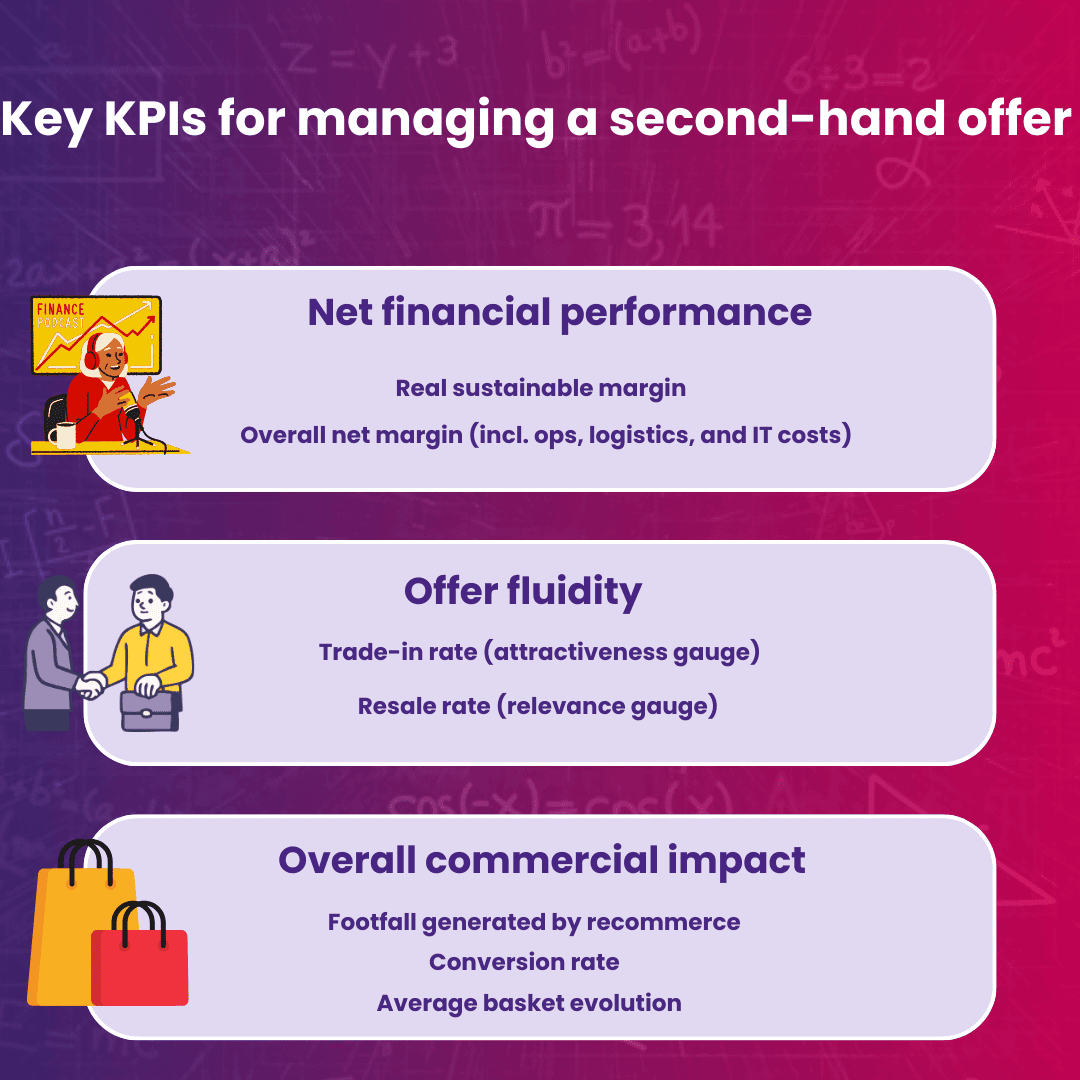
Financial management relies primarily on the actual margin generated by second-hand operations within a sustainable economy framework. Calculations should be based on net margin, integrating all operational, logistical, and IT Costs.
Flow indicators are also vital: the buy-back rate measures the program’s attractiveness, while the resale rate evaluates the relevance of the offer. Analyzing footfall, conversion rates, and average basket growth shows exactly how ReCommerce contributes to the network’s overall performance.
Success stories: what winning retailers have learned
Key success factors observed
Brands that succeed with second-hand share a clear vision of its role in their global model. They treat it as a structural driver, aligned with their core objectives and brand positioning. This clarity ensures consistent decision-making.
Another factor is operational mastery. High-performance systems rely on robust processes and tools tailored to the field. This allows companies to standardize quickly while maintaining the ability to adjust locally.
Success also comes from a piloted, progressive approach. Solid projects often start with a controlled scope and rely on precise KPIs. A continuous improvement mindset secures profitability and brings teams along on the transformation.
Common mistakes to avoid
The first mistake is launching a second-hand offer without a clearly defined business model. Many retailers underestimate real Costs or overestimate resale volumes.
Another common error is in-store execution. A lack of tools or training creates friction. Second-hand adds complexity that must be absorbed.
Furthermore, some retailers isolate second-hand from the rest of their strategy. By treating it as a separate channel, they miss out on its true value drivers. Success, instead, lies in integration. Second-hand must strengthen the existing ecosystem.
Why a progressive and piloted approach is essential
Second-hand touches many parts of the organization. An overly ambitious start increases operational risk. Companies should prioritize a gradual scale-up, starting with a controlled scope.
Data-driven management is at the heart of this approach. Progressive deployment allows for impact measurement and the identification of friction points. This capacity for rapid adjustment secures profitability.
Finally, a step-by-step approach fosters buy-in from in-store teams. It allows time for change management with Sales associates and integrates field feedback into the model’s evolution. By moving in stages, the retailer builds a robust system aligned with its capabilities.
Second-hand and unified commerce: a sustainable performance driver
Second-hand as a pillar of unified commerce
In a Unified commerce strategy, second-hand is treated as an integrated component of the company’s entire ecosystem. This unified approach ensures a consistent experience across every customer Touchpoint.
By orchestrating pre-owned inventory just like new products, retailers can offer a better Omnichannel journey. This integration connects second-hand to other performance drivers within a single, unified platform.
Unifying customer and employee journeys
For the customer, buy-backs, pre-owned purchases, and access to associated services must be part of a fluid journey consistent with new product experiences. The process must remain clear across all Touchpoints, both online and in-store.
To achieve this, field teams must rely on common tools that allow them to manage both new and second-hand items indifferently. This ease of use is critical for securing execution and maintaining a consistent level of service quality.
Preparing for the future: innovation, circularity, and retail agility
The circular economy is a major arena for innovation. It opens the door to new use cases—hybrid services, evolving offers, and product lifecycle valuation that go far beyond simple resale.
In practice, this dynamic boosts retail agility. Second-hand systems provide a concrete framework for quickly testing new propositions, leveraging data, and adjusting models based on usage. This continuous learning becomes a competitive advantage.
In the long term, circularity will become the standard for reducing environmental impact. By structuring second-hand within a Unified commerce platform, retailers lay the necessary foundation to integrate other circular economy drivers permanently.
Implementing a second-hand offer has become a strategic choice for retailers. When conceived as a business project and integrated into a Unified commerce platform, second-hand becomes a sustainable driver of performance.
By balancing profitability, customer engagement, and retail model transformation, sustainable commerce builds a solid framework aligned with consumers’ environmental and ecological expectations.
Frequently asked questions
How do I implement second-hand across a store network?
By defining a clear offer, standardizing in-store processes, securing the business model, and implementing an IT architecture capable of managing operations at scale.
Is the second-hand market profitable for major retailers?
- Yes, this market is profitable provided you anticipate operational Costs, define clear buy-back rules for pre-owned items, and track performance via dedicated KPIs. It is particularly relevant in the fashion sector, where environmental impact is high.
Do I need a specific tool to manage second-hand?
Second-hand requires specific capabilities (buy-back, quality control, pricing, item state tracking, KPI measurement) that must be integrated into the existing IT ecosystem, especially the POS.
What is the difference between ReCommerce and second-hand?
“Second-hand” refers to the customer-facing offer. ReCommerce encompasses the entire business model (operations, technology, Unified commerce platform, and global economics) that enables managing an object’s second life. It is part of a circular economy approach.