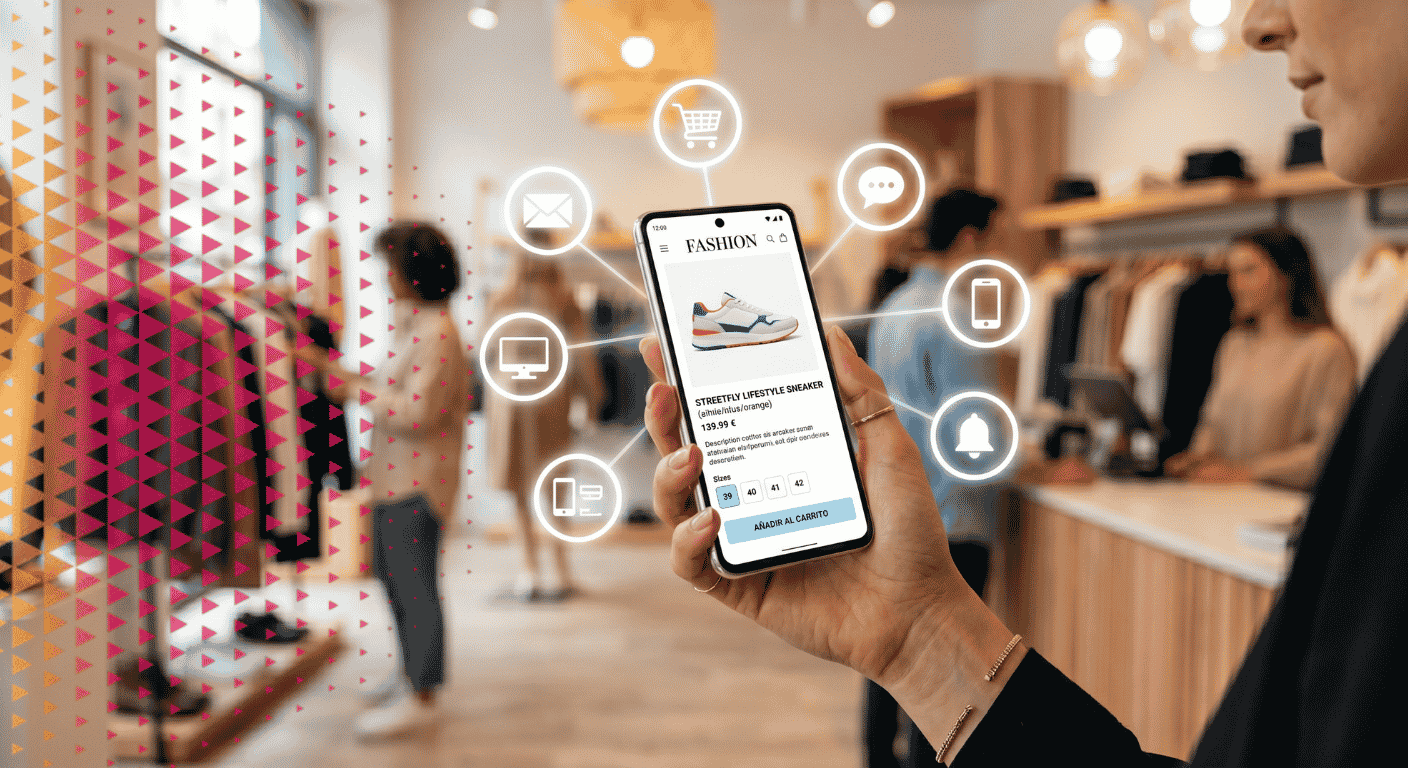


How to tell if you are truly operating in unified commerce or still stuck in omnichannel

Have you ever spotted a product “in stock” on a website, only to find it’s nowhere to be seen once you get to the store? This frustration isn’t just a glitch it’s a symptom. It highlights the gap between sales management that is merely connected (omnichannel) and one that is truly integrated (unified commerce). To tell them apart, we first need to look back at where this evolution began.
Originally, there was the multichannel strategy. Imagine a brand’s physical store and its website as two separate islands. Each functions well on its own but is completely unaware of the other. In this model, the company offers you multiple places to shop but builds no bridges between them. Ultimately, it’s up to you, the customer, to make the connection.
A classic example is the product return. You want to exchange an item bought online at a physical point of sale (POS), but the sales associate regretfully explains it’s impossible because their systems are completely separate. This is the multichannel experience at its most frustrating: “ground zero,” from which brands had to evolve to offer a truly seamless experience.
What is omnichannel? The promise of a (mostly) connected experience
For a long time, a brand’s website and physical store lived in two different worlds. One didn’t know what the other was doing, creating friction for you, the customer. To solve this, businesses shifted toward an omnichannel journey. The goal: ensure all touchpoints communicate with each other to make your shopping journey smoother.
To visualize omnichannel, imagine a team of specialists: the website expert, the store expert, and the mobile app expert. Omnichannel acts like a coach asking them to talk and collaborate. Each channel remains a distinct system, but they are connected to exchange key data. They are essentially learning how to pass the ball.
The most famous example of this strategy is Click & Collect. You order online (channel 1) and pick up your product in-store (channel 2). For this to work, the website must “talk” to the store’s inventory management system. This cross-channel collaboration is the heart of the omnichannel customer experience, making it far more convenient than in the past.
The keyword here is “connection,” not “fusion.” Just like any team where players pass to one another, communication isn’t always instant or perfect. It is precisely in these small gaps that the limits of omnichannel appear, marking the transition to the next stage: unified commerce.
Omnichannel “bugs”: Why your customer experience sometimes fails
This collaboration between the website, store, and app is a great promise, but you’ve likely noticed it’s not always perfect. The reason is simple: in an omnichannel strategy, systems are connected, not unified. Communication isn’t instantaneous. It’s like a conversation with a slight lag, where crucial info arrives too late. This imperfect data synchronization is the root of many frustrations.
The first symptom of this lag is “near” real-time stock visibility. That “near” makes all the difference. When a site says there is “1 item in stock” at your store, it’s often based on data from the day before or at best, a few hours ago. In the meantime, the item may have been sold. Similarly, fragmented data explains why you often have to repeat your story to different people. Website support might not see your in-store purchase history because each channel has its own database.
In short, the limits of omnichannel appear in familiar situations:
- Loyalty points taking 24 hours to update after an online purchase.
- Products showing as available online but being missing from the shelves.
- Having to re-explain a problem to a phone agent after already detailing it in a chat.
These aren’t isolated errors; they are the logical symptoms of systems that talk to each other but don’t share the same brain. So, how do we go further?
Unified commerce: When channels vanish into a single fluid experience
To move past these frustrations, innovative companies are no longer just trying to connect channels; they are merging them. This is unified commerce. It’s a game-changer that eliminates intermediaries and communication delays. The goal is no longer to get the website to talk to the store, but to ensure they share the exact same “brain.”
This is the fundamental shift. Instead of a team of specialists passing a ball (website, POS, app), imagine a single, versatile athlete who sees the entire field at once. Unified commerce relies on a single retail SaaS platform that natively manages customers, orders, inventory, and products across all points of sale. There is no “syncing” because the information is the same everywhere, at the same time.
What does this mean for you? Imagine adding a jacket to your cart on your smartphone during your commute. At lunch, you drop by the store. A sales associate greets you and, on their tablet, immediately sees your active cart. They can offer to let you try the item on and suggest a pair of trousers to match, based on your purchase history, because they truly know your preferences.
This fluidity isn’t magic. It is the direct result of a system where the displayed inventory is the actual inventory, updated to the second, and where every employee has a unified view of your relationship with the brand. Finally, the experience is truly seamless.
Omnichannel vs. Unified commerce: The decisive test
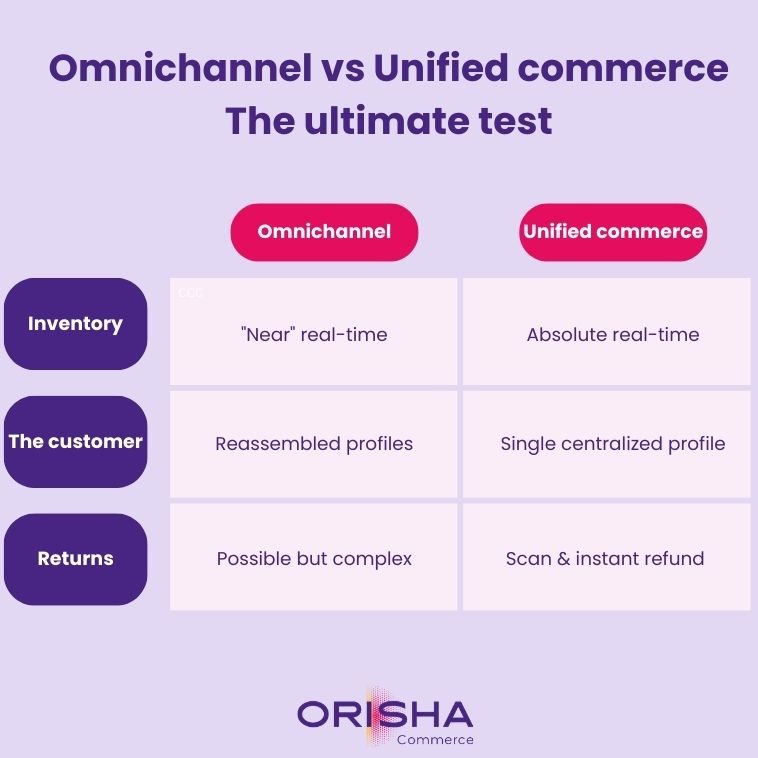
So, how do you know if your “seamless experience” is the result of good omnichannel or true unified commerce? The difference lies in the details, specifically across three areas: inventory management, the brand’s view of you as a customer, and the ease of returns / refunds.
The distinction is clearest when you compare these aspects directly. Think of it as the difference between a well-coordinated team and a single, multi-talented athlete.
- INVENTORY: In omnichannel, data is synchronized, meaning it’s “almost” up to date but can lag. In unified commerce, inventory is unified in real time. If one item remains, you know it instantly.
- THE CUSTOMER: Omnichannel patches together info from multiple sources. In unified commerce, you have a single centralized customer profile. The in-store associate sees the cart you just abandoned on the app.
- THE RETURN: Omnichannel often allows in-store returns for web items, but it’s a manual process for the staff. In unified systems, the associate scans the item, and the POS software triggers an instant refund.
The return test is the most revealing. If a sales associate can scan your e-commerce order on a mobile POS and initiate a refund on the spot without calling a manager, you are likely dealing with a unified commerce company. This total fluidity proves information is flowing without friction.
Beyond the tech: Why a fluid experience builds trust
Beyond efficiency, the impact of unified commerce is emotional. Knowing that online stock is 100% accurate isn’t just a time-saver; it’s a sign of respect that builds trust. When a shopping journey is frictionless from start to finish, it moves beyond “convenient” to deeply satisfying.
Being truly recognized by a brand changes everything. When a store associate sees your mobile cart and offers to help you finalize the purchase, the message is powerful: “We see you as one single customer, no matter where you are.” This high-level personalization transforms a transaction into a human interaction. You are no longer an anonymous order number, but a valued individual.
A practical guide to evaluating a retailer
Next time you interact with a brand, turn it into a mini-investigation. You can judge their maturity by checking these points:
- The abandoned cart test: Does the store associate have any idea what you looked at online? If they can see your current cart, it’s a strong sign of unified commerce.
- The precise stock question: Ask if a product is available at another location. An instant, reliable answer suggests centralized stock.
- The return ordeal: Try returning an e-commerce purchase in-store. Is it immediate? That’s the mark of unified commerce.
- Customer recognition: Are your loyalty points credited instantly? Does the brand recognize you everywhere? Fluid recognition is a key indicator.
Before, a missing promotion or wrong online stock was just a frustration. Now, it’s a clue. You understand the digital transformation of retail from multichannel to unified commerce. You can now see the difference between systems that are merely “connected” and an experience that is truly “unified.”
Put this new skill to work. Next time you interact with a brand, ask yourself: am I seeing a “team of specialists” passing a ball (omnichannel), or the “complete athlete” who masters the whole field effortlessly (unified commerce)?
You are no longer just a spectator of retail trends, but an expert capable of decoding the quality of an experience. Next time a shopping journey feels fluid, simple, or even “magical,” you’ll know that behind that simplicity lies the power of a truly unified vision.
FAQ : Omnichannel vs. Unified commerce
What is the fundamental difference?
Omnichannel connects existing systems (like a team passing a ball). Unified commerce merges them into one single “brain” in real time.
Why is online stock sometimes wrong in-store?
This is an omnichannel symptom due to “near” real-time sync. In unified commerce, the database is shared, so stock is accurate to the second.
How can I spot a unified commerce retailer?
Try the return test: an instant refund for a web order at the point of sale is the ultimate sign. Another clue is the associate’s ability to see your abandoned mobile cart.
Why does omnichannel create "friction"?
Because data is fragmented. Repeating your issue to support or waiting 24h for loyalty points shows the systems aren’t truly sharing one brain.
What is the impact on the customer relationship?
It builds trust. You feel recognized as one person across every touchpoint, turning a transaction into a personalized shopping experience.